Four years ago, we didn't start with a product. We started with a question.
Every meaningful innovation begins with curiosity.
For some, it's a question about technology.
For others, it's about business.
For us, it was about psychology education.
One simple question refused to leave our minds.
Why are psychology students expected to counsel real people before they've had enough opportunities to practice?
The more we searched for an answer, the more we realized the problem wasn't hidden. It was happening in classrooms, internship interviews, and therapy rooms across the country.
Students were learning psychology.
But many weren't getting enough chances to experience it.
A Classroom Full of Future Psychologists
Walk into any psychology classroom, and you'll find students with extraordinary passion.
Some dream of becoming clinical psychologists.
Some hope to work in hospitals.
Others want to support children, families, schools, or communities.
They spend years studying developmental psychology, counselling theories, psychopathology, psychological assessments, ethics, and research.
Ask them about Cognitive Behavioural Therapy, and they'll explain it confidently.
Ask them about Carl Rogers, and they'll tell you about empathy and unconditional positive regard.
Ask them about mental health disorders, and they'll discuss diagnosis and treatment approaches.
Their knowledge is impressive.
Yet when the time comes to begin a real counselling conversation, many quietly wonder,
"Am I actually ready?"
That question stayed with us.
The Gap Nobody Meant to Create
Psychology education has never lacked passionate teachers or committed students.
What it has lacked is enough opportunities to practice.
Unlike many professions, psychology depends on something that cannot be mastered by reading alone.
Listening.
Building trust.
Responding with empathy.
Managing silence.
Thinking clearly while someone shares their deepest emotions.
These are human skills.
And human skills develop through experience.
Yet many students enter internships having practiced only a handful of structured role plays before meeting their first real client.
It's not because colleges don't care.
It's because creating safe, realistic clinical practice at scale has always been difficult.
Confidence Isn't Taught. It's Earned.
One realization changed the way we looked at psychology education.
Students weren't struggling because they lacked intelligence.
They weren't struggling because they hadn't studied enough.
Most were struggling because every important conversation felt like their first one.
Imagine learning to drive by reading the rulebook but never sitting behind the steering wheel.
Imagine becoming a pilot after memorizing flight manuals but never entering a simulator.
No one would expect confidence in those situations.
Yet psychology students are often expected to develop clinical confidence with very limited opportunities to practice before stepping into internships.
Perhaps we've been asking too much of them.
What If Practice Came Before Performance?
That question slowly became another.
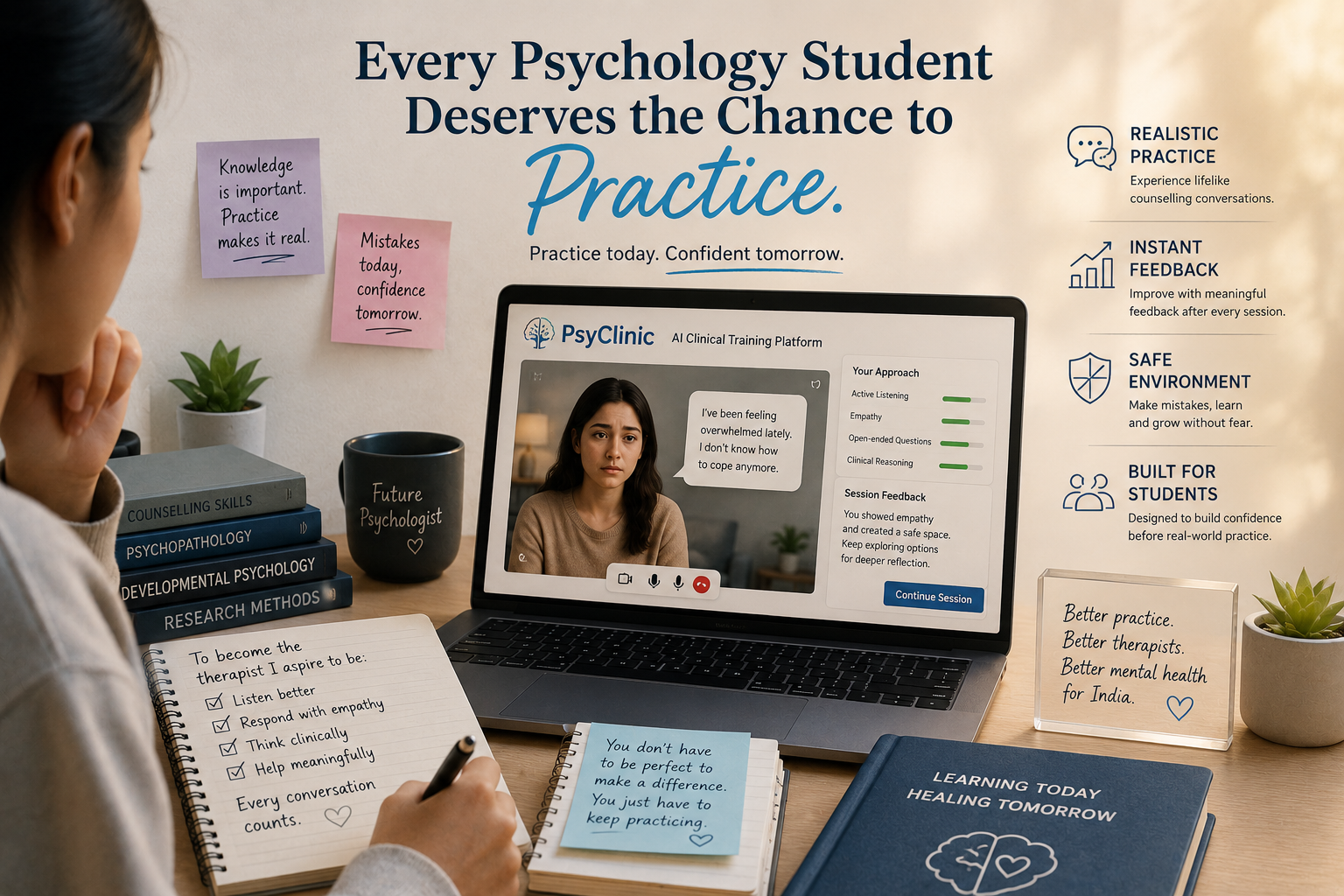
What if every psychology student could practice hundreds of counselling conversations before meeting their first real client?
Not through memorized scripts.
Not through imaginary scenarios.
But through realistic, dynamic conversations that challenge their listening, empathy, questioning, and clinical reasoning.
A place where mistakes become learning opportunities instead of lasting regrets.
A place where feedback isn't reserved for the end of an internship but becomes part of every practice session.
That vision became the foundation for PsyClinic.
Not as another learning platform.
Not as another assessment tool.
But as a clinical training environment where psychology students could safely develop the confidence that textbooks alone cannot provide.
Technology Should Support Education, Not Replace It
When people hear the words "AI in psychology," they often imagine technology replacing therapists.
We see something entirely different.
Technology should never replace human empathy.
It should help students develop it.
AI cannot understand the human experience the way a psychologist does.
But it can create realistic learning environments where students repeatedly practice, reflect, improve, and grow before those conversations carry real-world consequences.
The goal has never been to replace education.
The goal has always been to strengthen it.
Four Years Later
The question that started our journey still matters.
Perhaps even more than it did before.
Mental health awareness continues to grow.
More students are choosing psychology as a career.
Institutions are looking for better ways to prepare graduates for an evolving profession.
The demand for skilled mental health professionals has never been greater.
Yet the need remains the same.
Students deserve more than theoretical knowledge.
They deserve opportunities to practice.
To make mistakes.
To receive guidance.
To build confidence.
To become clinically ready before someone depends on them.
Looking Ahead
The future of psychology education will not be defined by textbooks alone.
It will be shaped by how effectively we combine knowledge with experience, technology with mentorship, and learning with practice.
If we can give every psychology student a safe space to grow before they step into the real world, we won't just build better graduates.
We'll build better professionals.
And ultimately, better care for the people who need it most.
Four years ago, we asked a question.
Today, we're still building the answer.
Because every future psychologist deserves the chance to practice before they're expected to perform.