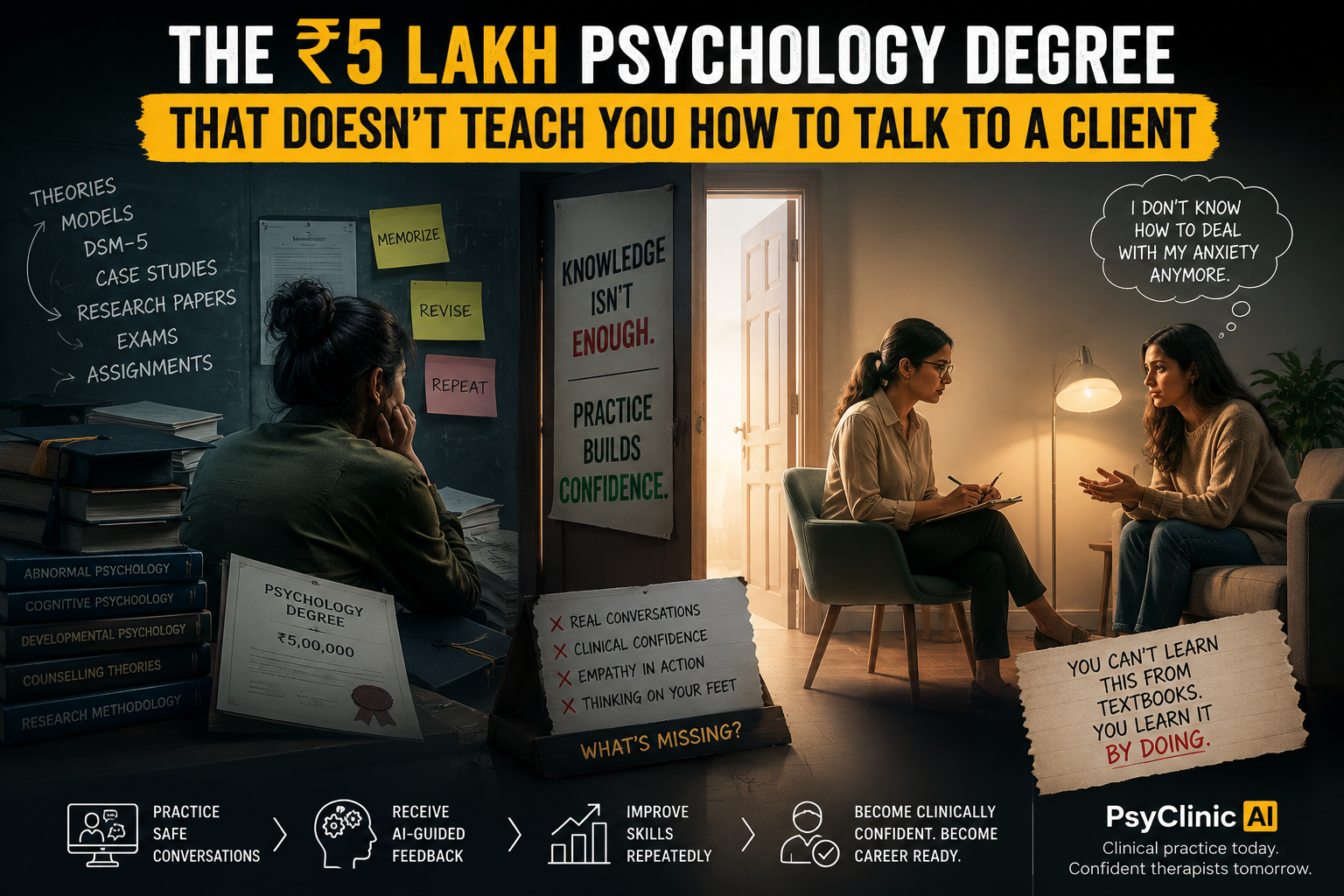
Imagine spending five years studying psychology.
You memorize developmental theories, counselling approaches, personality assessments, DSM criteria, research methods, and therapeutic models. You pass every semester, complete assignments, and proudly walk across the stage on graduation day with a degree in your hand.
Then, a week later, someone sits across from you and says,
"I don't know how to deal with my anxiety anymore."
And suddenly, everything you studied feels strangely silent.
You know the theories. You know the techniques. But you don't know how to begin the conversation.
For thousands of psychology graduates, this isn't imagination. It's reality.
The Invisible Gap
Psychology education has evolved tremendously over the years, but one challenge continues to persist.
Students spend hundreds of hours learning about people, but very few hours actually talking to people in therapeutic settings.
The result is a hidden confidence gap.
Students graduate academically qualified yet clinically uncertain. They know what empathy is, but struggle to express it naturally. They understand active listening, but panic when silence enters a session. They know the textbook definition of rapport, but have never had enough opportunities to build it.
The problem isn't knowledge.
The problem is practice.
Learning to Swim Without Entering the Water
Imagine teaching someone to swim using only books and classroom lectures.
They may understand floating techniques and breathing patterns perfectly, but the first time they enter deep water, panic takes over.
Clinical psychology often follows a similar pattern.
Students spend years preparing for conversations they rarely get to practice.
When internships finally begin, many students are having their first meaningful counselling interactions while being evaluated.
That's a heavy burden for any learner.
Employers Are Looking for Something Different
Today, colleges award degrees.
Employers look for readiness.
Internship supervisors notice communication.
Hospitals observe confidence.
Mental health organizations value presence, listening skills, and clinical reasoning under pressure.
None of these can be mastered through examinations alone.
The industry increasingly expects graduates who can connect with people, think critically, and respond authentically—not simply recall theories from memory.
The Missing Clinical Lab
Medical students practice in anatomy labs.
Pilots train in flight simulators.
Engineers work in laboratories.
But where do psychology students repeatedly practice counselling conversations before meeting real clients?
For many institutions, that answer is still unclear.
Role plays help, but they are limited.
Internships provide exposure, but often arrive too late.
Students deserve a space where they can practice, fail, improve, and repeat without fear of harming someone or being judged.
The Future of Psychology Education
The future of psychology education cannot rely on theory alone.
It must combine knowledge with simulation, supervision, reflection, and repeated practice.
Students need opportunities to experience realistic client conversations before stepping into clinical settings.
Because confidence isn't built by reading another chapter.
Confidence is built by doing.
A Different Way Forward
This is exactly where AI-powered clinical simulation is beginning to transform psychology education.
Instead of waiting months for limited internship opportunities, students can engage with realistic virtual patients, practice different counselling scenarios, receive structured feedback, and continuously refine their communication and clinical reasoning.
It's not about replacing human experience.
It's about preparing students for it.
Just as pilots train in simulators before flying passengers, future psychologists deserve safe environments where they can develop confidence before meeting real clients.
The degree may open the door.
But it is practice, reflection, and experience that prepare someone to walk through it with confidence.
And perhaps that's the lesson psychology education needs most today.