It was 9:17 in the morning.
Her phone vibrated.
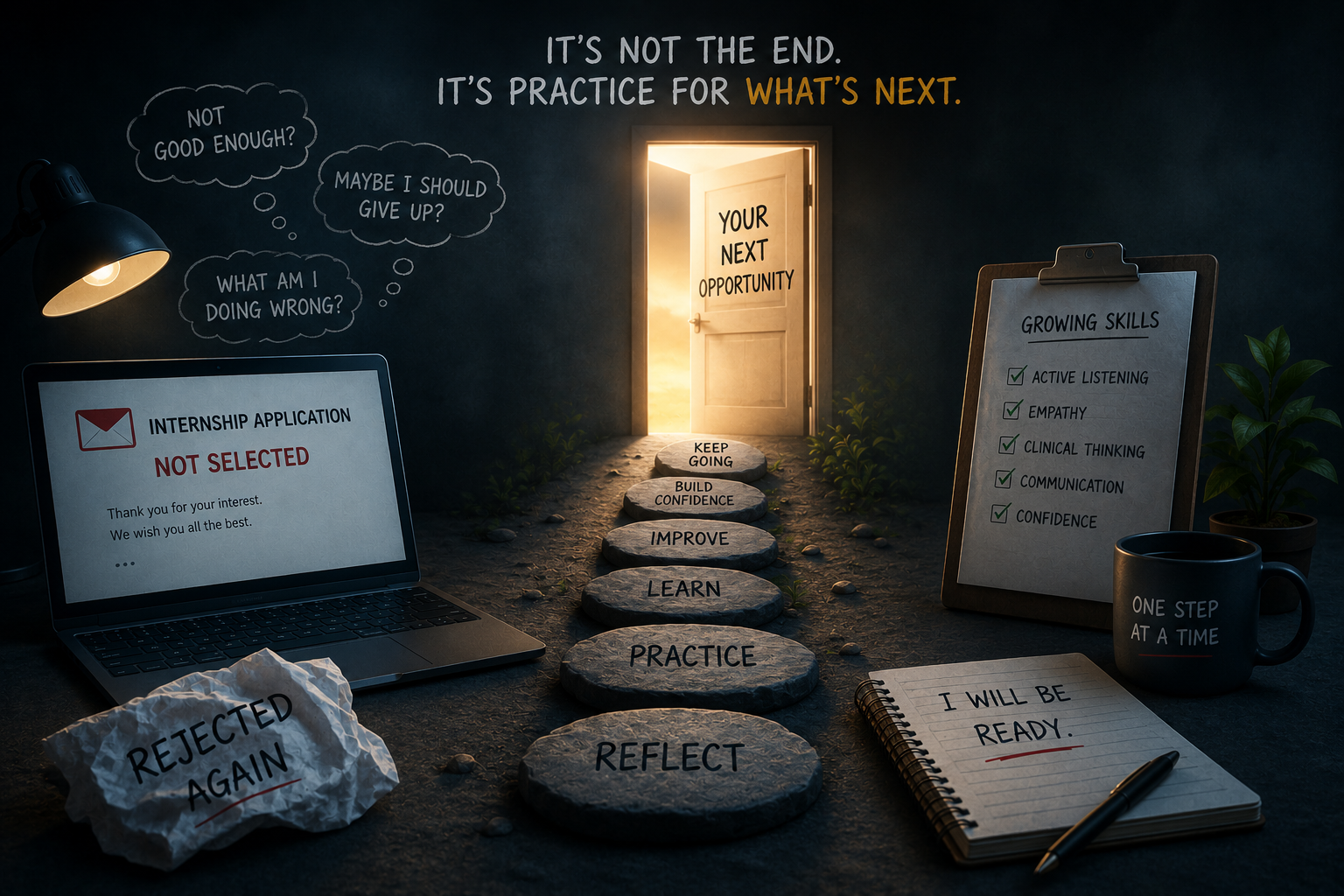
Like every other final-year psychology student, she had been refreshing her inbox every few hours for the past week. She had carefully prepared her resume, attended the interview, answered every question as confidently as she could, and walked out believing she had a genuine chance.
The subject line finally appeared.
"Regarding Your Internship Application."
Her heart raced.
She opened the email.
"Thank you for your interest. After careful consideration, we have decided to move forward with another candidate. We wish you all the best in your future endeavours.
She stared at the screen for several seconds.
Then she closed her laptop.
No tears.
No anger.
Just silence.
That silence felt louder than the rejection itself.
"Maybe I'm Just Not Good Enough."
It's a thought many psychology students never admit out loud.
After all, they worked hard.
They attended every lecture.
They studied developmental psychology, psychopathology, counselling theories, CBT, DBT, personality assessments, ethics, research methods, and case formulations.
They passed exams.
Completed assignments.
Graduated with respectable grades.
Yet somehow, they still couldn't secure an internship.
The rejection starts feeling personal.
"Maybe I chose the wrong field."
"Maybe I'm not confident enough."
"Maybe someone else simply deserves it more."
These thoughts quietly begin replacing excitement with self-doubt.
But What If the Rejection Wasn't About Intelligence?
A week later, she met one of her professors.
She expected advice about improving her resume.
Instead, the professor asked a simple question.
"Tell me about your interview."
She described everything.
The questions.
The answers.
The awkward pauses.
Then she remembered one particular moment.
The interviewer had asked,
"Imagine your client suddenly stops speaking during a counselling session. What would you do?"
She had frozen.
Not because she didn't know what silence meant.
She had written an entire exam answer about therapeutic silence.
She simply couldn't imagine herself inside that moment.
There was a difference between knowing and doing.
And for the first time, she realized that was exactly what the interview had exposed.
Degrees Open Doors. Confidence Walks Through Them.
Many psychology students believe interviews are testing their knowledge.
In reality, they're often evaluating something much deeper.
Can you communicate naturally?
Can you stay calm when conversations become unpredictable?
Can you think while listening?
Can you respond like a future professional rather than a student recalling textbook definitions?
These aren't qualities that suddenly appear after graduation.
They grow through repeated practice.
Unfortunately, this is where many students struggle.
Their first meaningful counselling conversation often happens during an internship interview or in front of a real client.
That's a difficult place to begin learning.
The Experience Paradox
Almost every internship posting asks for confidence, communication skills, or practical exposure.
Students look at those requirements and quietly ask themselves the same question.
"How do I gain experience if every opportunity expects experience first?"
It's a frustrating cycle.
No internship because of limited practical exposure.
No practical exposure because there is no internship.
For years, psychology education has relied on classrooms, occasional role plays, and limited internship opportunities to prepare students.
While these are valuable, they don't always provide enough repetition.
And confidence rarely comes from doing something once.
It comes from doing it again and again.
Practice Changes More Than Performance
Several months after her rejection, another opportunity arrived.
This time, something felt different.
Instead of memorizing interview answers, she had spent weeks practicing counselling conversations, exploring different client personalities, making mistakes, reflecting on feedback, and learning how to think in the moment rather than searching for perfect responses.
She wasn't trying to sound like a textbook anymore.
She sounded like herself.
When the interviewer asked,
"How would you begin your first counselling session?"
She didn't pause.
She simply answered as if someone were already sitting across from her.
The difference wasn't knowledge.
The difference was familiarity.
The situation no longer felt like the first time.
Building Confidence Before It Matters
The truth is, confidence isn't built inside interview rooms.
It's built long before students walk into them.
Every conversation practiced.
Every mistake reflected upon.
Every difficult question explored.
Every moment of uncertainty faced in a safe environment.
That's what slowly transforms hesitation into confidence.
Psychology is one of the few professions where communication isn't just an advantage—it is part of the skill itself.
Students deserve opportunities to develop that skill before someone evaluates them on it.
A New Way to Prepare
This is where psychology education is beginning to evolve.
Instead of waiting months for limited clinical exposure, students now have opportunities to practice realistic counselling conversations in structured, repeatable environments.
They can explore different client scenarios, experiment with different approaches, receive meaningful feedback, and improve gradually—without the pressure of getting everything right the first time.
It's not about replacing internships.
It's about arriving at internships already prepared to learn, contribute, and grow.
The Next Email
Months later, another email appeared.
The subject line looked almost identical.
Her heartbeat was just as fast.
She smiled before opening it.
Not because she knew the outcome.
But because this time, she knew something else.
Regardless of what the email said, she was no longer the same student who had opened the last one.
She had practiced.
She had improved.
She had learned to trust her own voice.
The email didn't change her confidence.
The preparation did.
And perhaps that's the lesson every psychology student deserves to learn before their first internship.
Sometimes, the most important acceptance doesn't arrive in your inbox.
It happens quietly, the moment you realize you're finally ready.