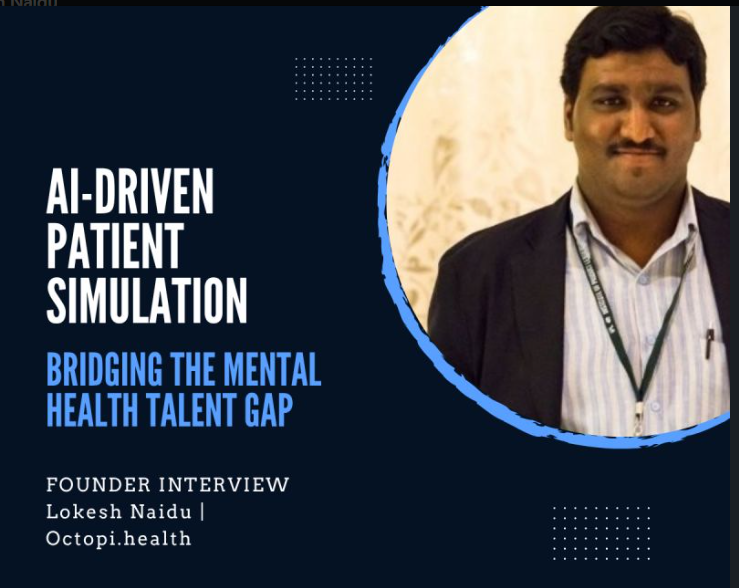
A Conversation with Lokesh Naidu, Founder of Octopi Health
The Growing Gap in Mental Healthcare
What happens when the demand for mental health support keeps rising, but the number of trained professionals doesn’t keep up?
This is not a future problem—it’s already happening.
During the COVID period in India, more lives were lost to suicide than to the virus itself. At the same time, access to trained psychologists remains limited, especially outside major cities. For a country of over a billion people, the number of licensed professionals is still extremely low.
This creates a critical question for educators and institutions:
Are we preparing enough skilled professionals for real-world mental health challenges?
From Corporate Leadership to Healthcare Innovation
Lokesh Naidu, Founder of Octopi Health, brings over 18 years of experience from global organizations like Robert Bosch in Germany and Boeing Aerospace in the United States.
While his early career focused on product management and AI-driven solutions, his long-term goal was always to build scalable products, not just services.
In 2018, he founded LokSun Technologies with a focus on artificial intelligence, particularly in computer vision. Over time, the company worked with global clients and built strong expertise in AI-based systems.
But a personal incident changed everything.
A Personal Turning Point
A close family member, who was a practicing psychologist, struggled with burnout from continuous patient care and eventually died by suicide.
This experience shifted the focus from technology to impact.
It raised an important concern:
Who supports the professionals who are supporting everyone else?
This led to the idea of building solutions not just for patients, but also for students and mental health professionals.
The Hidden Problem in Psychology Education
One of the biggest challenges in psychology education is the lack of practical exposure.
Unlike other medical fields, students cannot easily observe real therapy sessions due to confidentiality. As a result, most learning remains theoretical.
Students often enter internships without ever experiencing a real conversation with a patient.
This gap affects confidence, communication, and overall readiness.
Introducing AI-Based Simulation for Training
To address this, Octopi Health developed PsyClinic, an AI-powered patient simulation platform.
PsyClinic allows students to:
- Practice therapy sessions with virtual patients
- Experience different emotional and behavioral scenarios
- Handle complex cases with multiple conditions
- Continue sessions over time for deeper learning
The platform uses multimodal AI, combining:
- Facial expression analysis
- Voice emotion detection
- Language understanding
This creates a more realistic and interactive learning environment.
Beyond Students: A Complete Mental Health Ecosystem
Octopi Health is not limited to just one solution. It has built a portfolio of products addressing different needs:
- AI Simulation Lab (PsyClinic): For student training
- Digital Therapy App (ZALK): For individuals seeking support
- Clinical Support Tools: For psychologists to analyze sessions
- Screening Tools (PsycAI): For pre-consultation assessments
- Wearable Devices: For continuous monitoring of stress, sleep, and activity
Together, these solutions aim to improve both access to care and quality of care.
Rethinking Professional Training and Upskilling
Another major gap exists even after psychologists are licensed.
While supervision and upskilling are recommended, they are often:
- Expensive
- Time-consuming
- Difficult to access
Many professionals continue practicing based on outdated knowledge.
Simulation-based tools like PsyClinic could offer a scalable way to support continuous learning and standardization across the profession.
Adoption by Institutions
PsyClinic is already being adopted by universities and colleges.
Institutions are using it to:
- Improve practical learning
- Prepare students before internships
- Strengthen their academic offering
In many cases, colleges also use such platforms as a differentiator to attract students by showcasing early adoption of AI in education.
A Shift Toward Practice-Based Learning
One important insight from early adoption is clear:
When practical training becomes part of evaluation, student engagement increases significantly.
Simulation-based learning is not just an add-on—it becomes more effective when integrated into the academic structure.
Looking Ahead
The future of psychology education is likely to move toward a balance of theory and simulation-based practice.
With growing mental health challenges globally, the need is not just for more professionals—but for better-prepared professionals.
AI-driven platforms like PsyClinic are not replacing educators.
They are supporting institutions in bridging the gap between classroom learning and real-world application.
Conclusion
Mental health care cannot scale without improving how professionals are trained.
By combining technology with education, institutions now have an opportunity to prepare students more effectively, reduce learning gaps, and ultimately improve care outcomes.
The question is no longer whether change is needed—
but how quickly we are willing to adopt it.