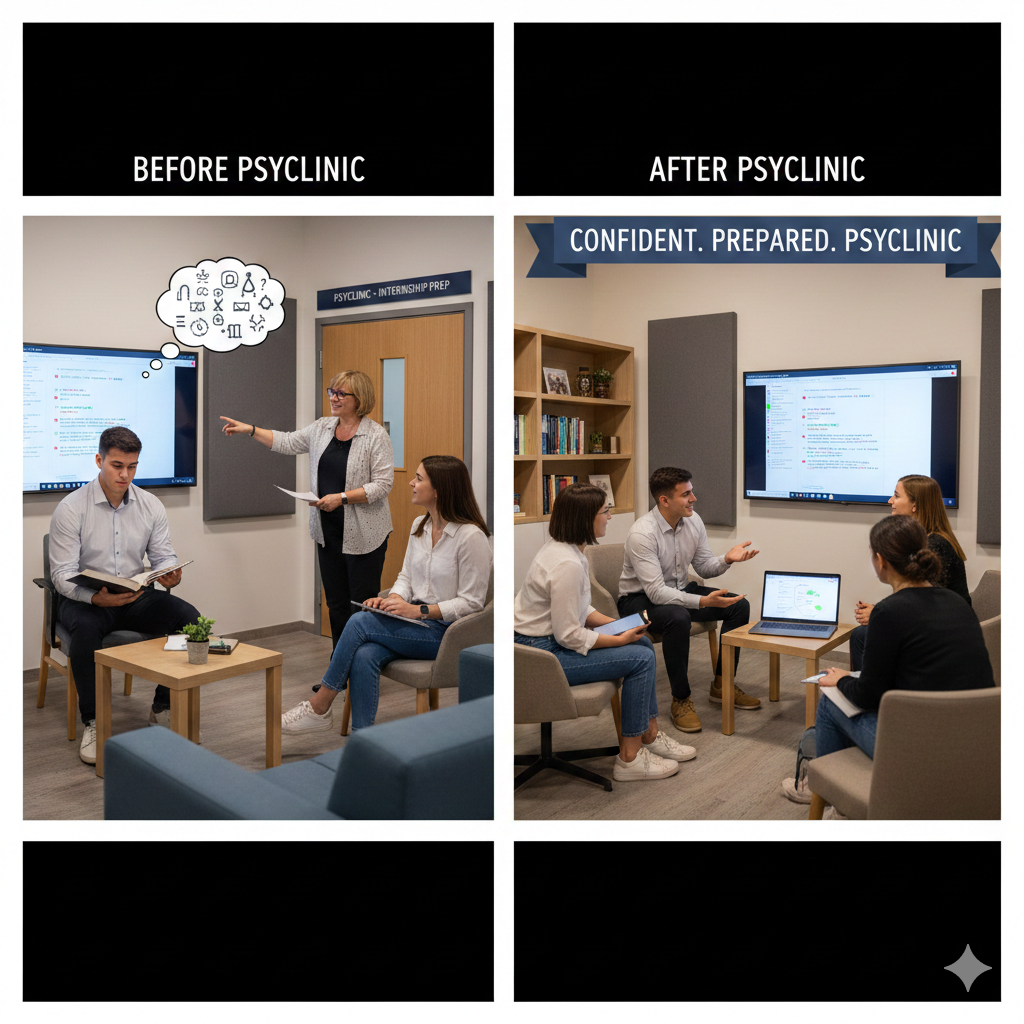
Every year, the arrival of internship feedback felt a bit like opening a predictable recurring report. As educators, we’d scan the comments from supervisors and see the same story unfolding over and over.
The feedback was never harsh, but it was honest. "Your students are brilliant," the supervisors would tell us. "They know the textbooks inside out. They can cite the theories and explain the diagnostic criteria perfectly. But..."
There was always a "but".
When it came time to actually sit across from a real person in a real session, that brilliant student would hesitate. You could see the "mental loading" icon spinning as they tried to translate a paragraph from a textbook into a natural, empathetic human response. They were essentially being asked to perform on a high-stakes stage without ever having a dress rehearsal. Naturally, that created a cocktail of stress and uncertainty.
The Realization
We realized we were throwing our students into the deep end and hoping they’d remember the physics of buoyancy to keep them afloat. They were learning the most critical parts of their profession while being actively evaluated, which is a recipe for anxiety, not mastery.
Enter PsyClinic: The Safe Harbor
We decided to build a bridge over that gap. We introduced PsyClinic—not as another class, but as a dedicated preparation space.
It became a "flight simulator" for future therapists. Here, the stakes were low, but the practice was high-fidelity. Students could:
- Practice the "Tricky" Conversations: Navigating a sudden silence or a difficult question.
- Fine-tune Responses: Finding their own voice instead of sounding like a script.
- Master the Flow: Getting comfortable with the rhythm of a session before a real client's well-being was on the line.
The Transformation
The shift was almost immediate. Within just a few weeks of using this "safe space" to practice, the feedback from internship supervisors didn't just get better—it underwent a fundamental change.
The reports of "hesitation" were replaced with notes on confidence, smoother communication, and a calm, grounded presence. The students were no longer "trying for the first time" when they met their first patient. They had already been there. They had already practiced. They weren't just students anymore; they were prepared professionals.