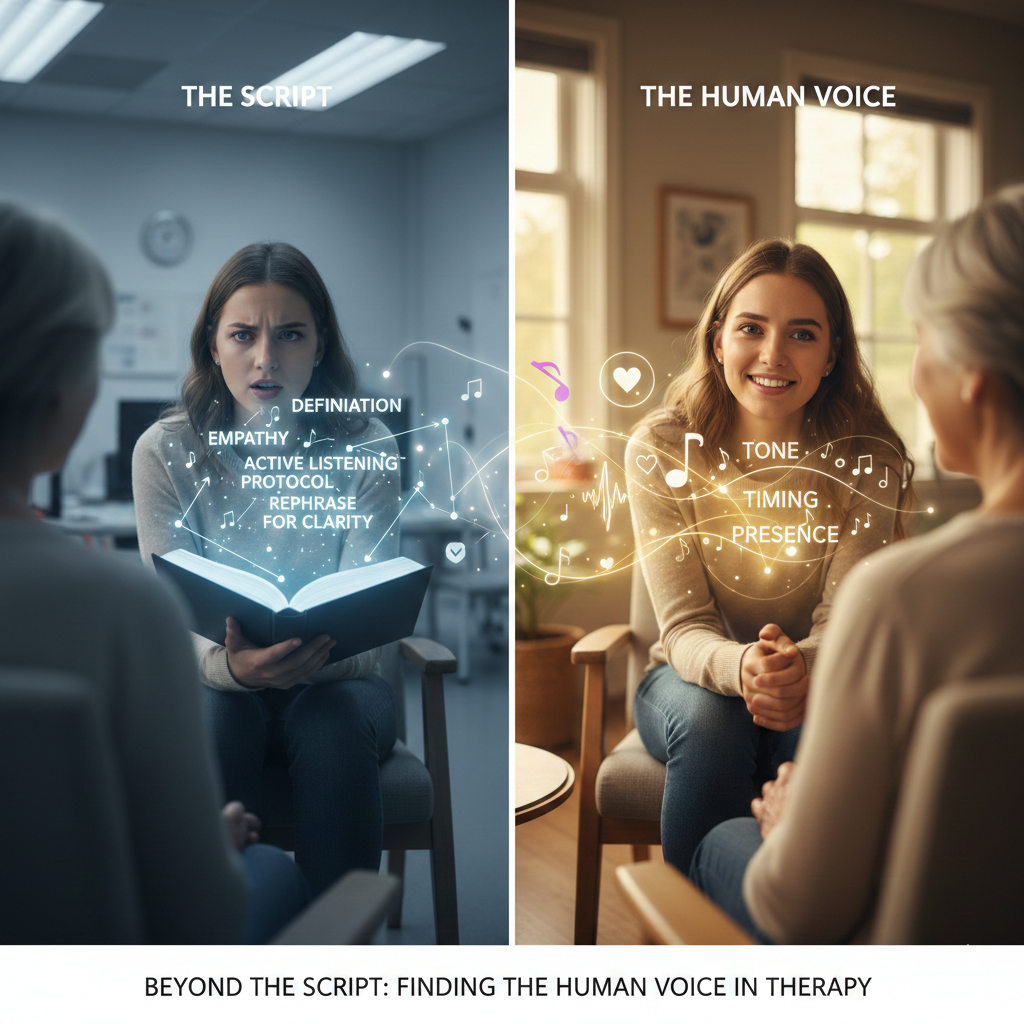
It’s one of the most common and quietest struggles in a psychology student’s journey. In the classroom, empathy is a clear, noble concept. We define it, we study its impact, and we all agree it is the heartbeat of the therapeutic relationship.
But then comes the moment of truth. A student sits down, leans in, and prepares to offer support. They feel the weight of the client’s story. They care deeply. Yet, when they open their mouth, something feels... off.
One student put it into words perfectly: “I knew exactly what I wanted them to feel, but the words coming out of my mouth sounded like I was reading from a dusty manual. It felt rehearsed. It felt fake.”
The "Robotic" Phase
This is the "uncanny valley" of clinical training. When you are hyper-aware of your technique, your empathy often gets trapped in a cage of "perfect" sentences. You’re so worried about saying the "right" thing that you lose the most important thing: presence.
We realized that empathy isn't a vocabulary test. It’s a symphony of:
- Tone: The warmth and steadiness of your voice.
- Timing: Knowing when to speak and, more importantly, when to hold the silence.
- Presence: Being truly there instead of planning your next sentence.
Why Repetition is the Secret Ingredient
These elements don't arrive in a "eureka" moment. They are muscles. Just as a musician practices scales until they can play a soulful melody without looking at their fingers, a therapist must practice the "scales" of conversation until the technique fades into the background.
This is where the PsyClinic environment changes the game. It provides a low-pressure laboratory where students can:
- Trial and Error: Try a response, realize it sounded "scripted," and try it again with a different inflection.
- Desensitize the Nerves: By practicing empathetic exchanges dozens of times, the "performance anxiety" begins to melt away.
- Find Their Own Voice: Moving past the textbook definitions to find a way of speaking that is both professional and authentically them.
The Shift to "Flow"
Over time, a beautiful transformation happens. The stuttering pauses and the "rehearsed" feeling start to disappear. The student stops thinking about "how to be empathetic" and simply is empathetic.
The conversation begins to flow naturally. The "script" is gone, and in its place is a human being who knows how to hold space for another. At PsyClinic, we aren’t just teaching students what to say, we’re helping them find the confidence to say it from the heart.