Author: Chigru, based on the content provided by Sangeetha Vasudevan
Our thoughts influence how we perceive ourselves, respond to situations, and approach everyday challenges. When negative thinking becomes a familiar pattern, it can be difficult to imagine responding to life with greater confidence and positivity. Mind management encourages us to become more aware of these patterns and consciously practise alternative ways of thinking.
In her approach to mind management, Personality Development Trainer Sangeetha Vasudevan introduces a three-step method she calls the “Mind Deceiving Technique.” The technique focuses on gradually shifting self-talk from negative statements towards positive, strength-oriented affirmations.
This article explores the three steps, the examples shared in her material, and how positive self-talk can be incorporated into everyday reflection.
What Is Mind Management?
Mind management, as discussed in Sangeetha Vasudevan’s material, involves paying attention to the flow of thoughts and practising ways to shift habitual negative thinking towards more positive self-talk.
Thinking often happens automatically. A person may repeatedly describe themselves as weak, incapable, or unsuccessful without consciously questioning these thoughts. Over time, such statements can become familiar ways of interpreting personal experiences.
For example, consider the difference between these two statements:
- Negative self-talk: “I’m sick and weak.”
- Positive self-talk: “I’m healthy and strong.”
These examples illustrate two different ways of describing oneself. The central idea behind the proposed technique is to practise constructive, strength-oriented language rather than repeatedly reinforcing negative descriptions.
Positive self-talk does not mean ignoring difficulties or pretending that challenges do not exist. Instead, it offers an opportunity to notice the language we use about ourselves and consider whether a more constructive statement is possible.
Understanding the “Mind Deceiving Technique”
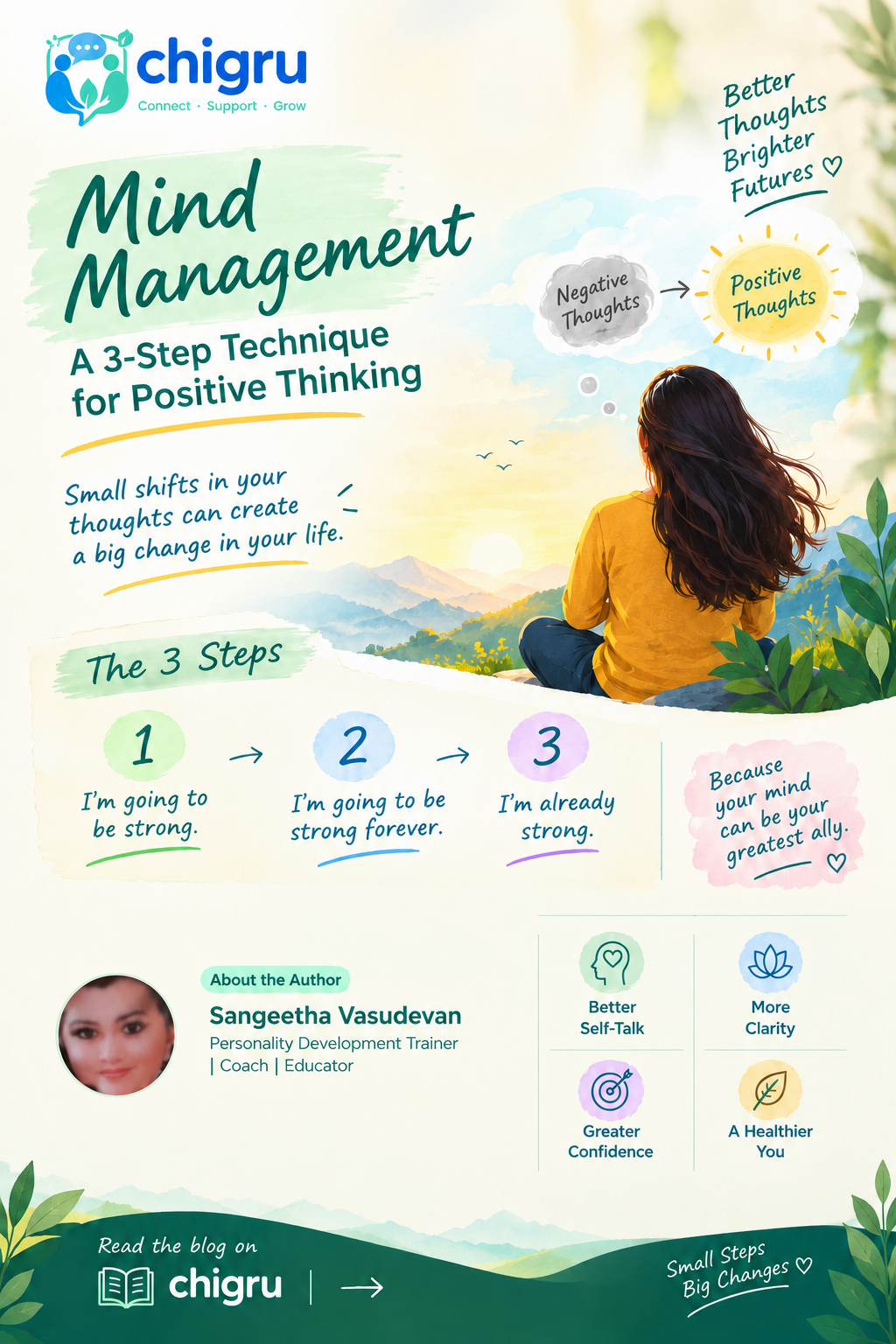
Sangeetha Vasudevan describes a three-step process intended to move self-talk towards a more positive direction. The steps progress from an intention for change, to maintaining that intention, and finally to expressing the desired quality as a present-tense affirmation.
The three statements are:
- “I’m going to be strong.”
- “I’m going to be strong forever.”
- “I’m already strong.”
Each statement represents a different stage in the technique.
Step 1: “I’m Going to Be Strong”
The first step focuses on initiating a change in the way we speak to ourselves.
As described in the supplied material, this statement can be used even when a person does not currently feel strong. The emphasis is on expressing an intention to move towards a more positive way of thinking.
For example, someone who frequently tells themselves, “I cannot handle this,” might pause and consider a different statement: “I’m going to be strong.”
The purpose of this step is to begin changing the language used in internal conversations. Rather than treating a negative description as the only possible way to understand a situation, the person practises expressing an intention to respond differently.
The key idea: Begin with an intention. A change in self-talk can start with a single statement that reflects the direction in which you want to move.
Step 2: “I’m Going to Be Strong Forever”
The second step focuses on maintaining the positive direction introduced in the first step.
According to Sangeetha’s description, this stage involves continuing to practise the chosen thought rather than treating it as a one-time exercise.
For example, a person who wants to develop greater confidence might repeatedly remind themselves, “I’m going to be strong forever.”
The emphasis is on consistency. When familiar negative thoughts return, a person can notice them and consciously revisit the positive statement they have chosen to practise.
This does not require denying difficult emotions or expecting to feel confident at every moment. People can experience uncertainty, disappointment, and fear while still working towards a more constructive relationship with themselves.
The key idea: Repetition is part of the proposed practice. Consistently revisiting a positive statement may help a person become more familiar with that way of expressing themselves.
Step 3: “I’m Already Strong”
The final step moves from an intention about the future to an affirmation expressed in the present.
Instead of saying, “I’m going to be strong,” the statement becomes, “I’m already strong.”
In Sangeetha’s technique, this is the final stage of the process. It encourages the person to practise describing themselves using the positive quality they want to reinforce.
The same structure can be explored with other positive adjectives, such as capable, confident, or resilient. For instance, someone working on their confidence might practise the statement, “I’m capable of learning and improving.”
These statements are best used as reminders of personal strengths and aspirations, rather than as proof that every difficulty has already been overcome.
The key idea: Use present-focused, constructive language to remind yourself of the qualities you want to recognise and develop.
Why the Words We Use About Ourselves Matter
The supplied material places particular emphasis on choosing positive adjectives such as strong and healthy rather than defining oneself through negative descriptions.
It also advises avoiding statements such as “I’m no more sick,” suggesting that the negative word in the sentence may remain the focus. This explanation is part of the approach presented in the source material.
From a practical self-reflection perspective, the example highlights an opportunity to choose wording that expresses a constructive intention. For instance, a person might say, “I want to take positive steps towards my well-being,” rather than repeatedly describing themselves in discouraging terms.
It is important, however, to distinguish the proposed technique from claims about how the world works. The supplied material refers to positive and negative vibrations from the Earth, but it does not establish that thoughts attract external energy signals or cause a person to become ill. Such explanations should not be treated as scientifically established facts.
Similarly, positive affirmations cannot guarantee a particular outcome or replace medical care, psychological support, or practical action when these are needed.
How to Practise Positive Self-Talk in Everyday Life
The three-step technique can be explored as a short self-reflection exercise. The following routine adapts the supplied statements into a simple daily practice.
1. Notice your usual self-talk.
Pay attention to the words you use when you face a difficult task, make a mistake, or feel uncertain. Avoid judging yourself for having negative thoughts; simply notice the pattern.
2. Choose a constructive statement.
Select a positive quality that is meaningful to you, such as strength, confidence, or capability. Keep the statement simple and relevant to your current goal.
3. Practise the three statements.
Use the structure suggested by Sangeetha’s technique:
- “I’m going to be strong.”
- “I’m going to be strong forever.”
- “I’m already strong.”
You can explore the same structure with another quality, such as confidence or capability.
4. Connect your words with realistic action.
If your affirmation is about confidence, identify one small action that supports it. You might prepare for a conversation, practise a presentation, or ask a question when something is unclear.
5. Reflect without expecting perfection.
Notice how you respond to the exercise over time. Some statements may feel natural, while others may feel difficult to believe. You do not need to force yourself to feel positive at all times. The aim is to practise a more constructive way of speaking to yourself while acknowledging your actual experiences.
Positive Thinking Is Not About Ignoring Difficulties
A positive approach to self-talk should leave room for honesty. Feeling sad, worried, disappointed, or physically unwell does not mean a person has failed to think positively.
For example, someone dealing with an illness can acknowledge their symptoms while using encouraging language about the steps they are taking to care for themselves. A person experiencing work-related stress can recognise the pressure they face while reminding themselves that they can seek support and consider their options.
The “Mind Deceiving Technique,” as described in the supplied material, centres on changing the wording and direction of self-talk. It should not be interpreted as a method for diagnosing, preventing, or curing physical or mental health conditions.
When persistent negative thinking affects daily functioning or causes significant distress, seeking support from a qualified mental health professional may be helpful.
Conclusion: A More Conscious Relationship With Your Thoughts
Mind management begins with noticing how we speak to ourselves. Sangeetha Vasudevan’s three-step “Mind Deceiving Technique” offers a structured way to explore positive self-talk: begin with an intention, practise maintaining it, and express the desired quality through a present-focused affirmation.
The three statements. “I’m going to be strong,” “I’m going to be strong forever,” and “I’m already strong” form the core of the approach she describes.
Positive affirmations are not a substitute for practical action or professional support, but they can serve as prompts for self-reflection. By becoming more aware of our internal language, we can explore more constructive ways to describe ourselves and approach everyday challenges.
The goal is not to force every thought to be positive. It is to develop a more conscious, balanced, and supportive way of relating to our thoughts.
About Sangeetha Vasudevan
Sangeetha Vasudevan is a Personality Development Trainer based in Bangalore. Through Sangeetha Personality Development Training, she works with adolescents, young adults, and working professionals on areas including self-confidence, self-awareness, communication, emotional intelligence, positive thinking, goal setting, and personal effectiveness.
Her training approach emphasises practical learning, active participation, self-reflection, and applying skills in everyday life. Training is available through individual coaching, group sessions, and workshops in online and offline formats.
Read her previous Chiguru feature: Meet the Trainer: Sangeetha Vasudevan’s Approach to Personality Development
Contact Sangeetha Vasudevan
- Phone/WhatsApp: 8971760484
- Email: sangeethah2015@gmail.com
- Location: Bangalore, India
Editorial note: This article is based on information supplied by Sangeetha Vasudevan. The “Mind Deceiving Technique” is presented as described in the supplied material; claims about Earth vibrations and their effects on health are not established by that material as scientific evidence. This article is for general educational purposes and is not a substitute for professional medical or psychological advice.