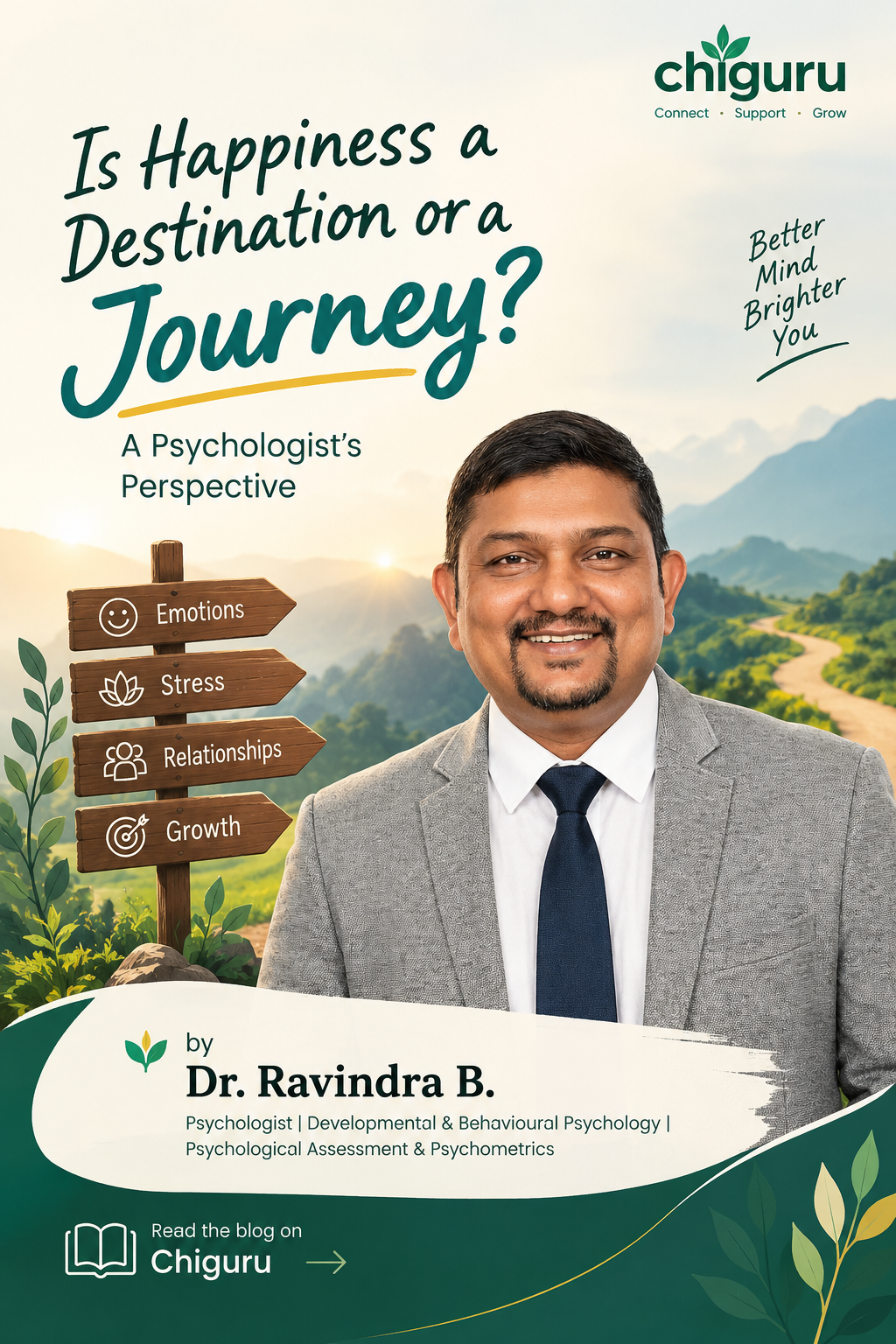
Understanding happiness, emotional well-being, stress management, and the way we respond to life's challenges.
Happiness is something many people strive for, but is it a destination we eventually reach, or a journey that continues throughout life? This question invites us to reflect on our expectations, emotional responses, personal goals, and the way we approach everyday challenges.
In a discussion shared by Dr. Ravindra B., a psychologist and master trainer with over two decades of professional experience, happiness is presented as a journey rather than a final destination. The discussion explores related questions: How can we manage emotions? Can stress be avoided? How should we respond to difficult people and challenging situations? Why do some people criticise others, and what does positivity really mean?
These questions are connected by a common theme: understanding our responses to life's experiences.
Drawing on the topics covered in Dr. Ravindra B.’s discussion and his professional profile, this article explores the relationship between happiness, emotional management, stress, and everyday behaviour.
1. Happiness Is a Journey, Not a Destination
Many people associate happiness with reaching a particular milestone. It may be achieving a goal, progressing in a career, improving a personal situation, or reaching a stage of life they have been working towards.
However, the idea that happiness is a journey rather than a destination encourages a different perspective. Instead of treating happiness as something that begins only after a goal has been achieved, we can reflect on how we approach the experiences that make up our lives.
Dr. Ravindra raises the question, “How can I be always happy?” and frames happiness as a journey rather than a destination.
This perspective invites us to consider happiness alongside the challenges, changes, and responsibilities that are part of everyday life. Life does not always unfold according to our expectations, and not every situation produces the same emotional response.
The journey perspective encourages ongoing reflection rather than the pursuit of a permanent state that must be achieved before life can feel meaningful.
It also connects with the importance of emotional management, stress responses, personal accountability, and the way we approach our goals.
A useful question to reflect on is: Am I waiting for everything to become perfect before allowing myself to appreciate my journey?
2. Understanding and Managing Emotions
Emotions are an important part of how people experience situations and respond to the world around them. Learning to manage emotions is one of the central themes in Dr. Ravindra’s discussion.
He explores both universal techniques and customised techniques for managing emotions. This distinction highlights two ideas: approaches that may be broadly applicable and approaches that are adapted to particular needs.
Not every person experiences a situation in the same way. A response that feels appropriate in one context may need to be reconsidered in another. Understanding the context in which an emotion arises is therefore an important part of reflecting on how to respond.
Emotional management can also be considered alongside the question of happiness. If happiness is a journey, our experiences along the way will not always be pleasant. We may encounter frustration, disappointment, uncertainty, or pressure.
The aim of managing emotions is not to assume that every experience must feel positive. Instead, the discussion encourages us to consider how we respond to the emotions that arise.
This is relevant to personal goals, relationships, workplace interactions, and challenging situations in everyday life.
3. Can We Avoid Stress?
Another question explored in the discussion is whether stress can be avoided entirely.
Dr. Ravindra introduces three forms of stress: eustress, stress, and distress. These terms encourage us to look beyond treating every experience of stress as identical.
The question of avoiding stress can lead to a broader reflection on how we respond when demands, expectations, or circumstances become challenging.
At different points in life, people may face personal responsibilities, workplace demands, changes in relationships, or situations that require difficult decisions. The experience of stress may vary depending on the circumstances and the individual.
Rather than focusing only on whether stress can be eliminated, it is useful to consider how we recognise and respond to it.
Dr. Ravindra's discussion moves from the different forms of stress to the question of how stress can be managed. This creates a connection between recognising an experience and deciding what to do next.
Understanding stress in this way also relates to the larger theme of happiness as a journey: challenging experiences may form part of life, and the way we approach them deserves attention.
4. Managing Stress Through the ABCD Strategy
Dr. Ravindra discusses stress management through an ABCD strategy:
- A — Avoid
- B — Bypass
- C — Confront
- D — Destroy
These are the terms used in the discussion. They provide a framework for considering different responses to a stressful situation.
The inclusion of these four approaches invites reflection on how we respond when something creates pressure or difficulty. Not every situation necessarily calls for the same response, and understanding the circumstances is important when considering what action to take.
The ABCD strategy is also discussed in connection with handling difficult people, with attention to age.
The supplied material does not provide detailed instructions for applying each option in every situation. It is therefore best understood here as the framework presented in Dr. Ravindra's discussion rather than a universal formula for every stressful experience.
The broader point is that stress management involves considering the situation and the possible ways of responding to it.
5. How to Handle Difficult People
Difficult interactions can arise in personal relationships, workplaces, and other everyday settings. Dr. Ravindra addresses this subject by discussing opinions or advice and introducing the ABCD strategy in relation to age.
This topic invites us to reflect on the difference between hearing another person's perspective and deciding how to respond to it.
People may offer opinions or advice that we agree with, disagree with, or find difficult to accept. An interaction can become more complicated when expectations differ or when people approach a situation from different perspectives.
A thoughtful response begins with understanding what is happening in the interaction and considering how to proceed.
The discussion's reference to age also indicates that the approach is not presented as entirely separate from the person or situation involved.
The supplied outline does not give a detailed, age-specific procedure, so it would be inappropriate to invent one. Instead, the key takeaway is to consider context when thinking about responses to difficult people.
This connects with emotional management: the way we handle an interaction is one part of the larger journey of understanding our responses and navigating life's challenges.
6. Responding to Catastrophic Situations
Dr. Ravindra also explores how people can approach catastrophic situations. The discussion introduces three terms to describe possible ways of responding: reactive, comparative, and responsive. It also raises the question of what a successful person might do in such a situation.
These terms provide a way to reflect on how people approach difficult circumstances.
A reactive response, a comparative response, and a responsive approach are presented as different ideas for consideration. The supplied material does not define each term in detail, but it draws attention to the way a person approaches a challenging event.
The question is particularly relevant when circumstances feel overwhelming or when an immediate emotional response is strong.
Rather than assuming that all difficult situations can be handled in the same way, this discussion invites us to think about the nature of our response and the decisions we make under pressure.
It also reinforces the relationship between emotional management and personal accountability. How we respond to a situation is an important consideration when navigating challenges, even when we cannot control every aspect of what happens.
7. Why Do Some People Criticise Others?
Dr. Ravindra explores why some people criticise others or try to pull them down. The discussion introduces two ideas: handling a pessimistic outlook and conveying a decision rather than seeking approval.
This topic is relevant to situations in which people encounter repeated criticism, disagreement, or discouraging opinions.
It is useful to distinguish between hearing another person's perspective and allowing that perspective to determine every decision we make.
The idea of conveying a decision rather than seeking approval, as outlined in the discussion, raises a question about personal accountability. It invites reflection on how we communicate decisions and how we respond when other people do not agree with us.
This does not mean that every criticism should be dismissed. Rather, it highlights the importance of considering how we approach other people's opinions and how we communicate our own decisions.
The discussion connects this subject with a pessimistic outlook, but the supplied material does not establish a single explanation for why people criticise others.
For readers, the practical reflection is to consider how they communicate, how they receive feedback, and how they approach decisions when opinions differ.
8. What Does Positivity Really Mean?
Dr. Ravindra explores the meaning of positivity through three terms: optimism, pessimism, and realism. The discussion also presents the phrase “Optimism + Work.”
This framing connects a positive outlook with effort rather than presenting positivity as a matter of attitude alone.
Optimism, pessimism, and realism offer different perspectives through which people may approach situations. The discussion brings these concepts together to examine what positivity means.
The phrase “Optimism + Work” suggests a connection between a hopeful outlook and taking action. Having a positive expectation is one thing; working towards a goal is another part of the process.
This idea also relates to happiness as a journey. Goals and aspirations often require continued effort, and progress is not always immediate.
Instead of viewing positivity as a requirement to feel happy in every situation, readers can reflect on how their outlook relates to their actions, responsibilities, and goals.
9. Understanding Dominance and Leadership
Dr. Ravindra discusses why some people want to dominate others. The topics outlined include survival of the fittest, strength, cleverness, natural versus position-based leadership, and the distinction between bullying and communication strategies.
These themes invite reflection on how people exercise influence and how leadership can be understood in different contexts.
The discussion distinguishes between natural leadership and leadership based on position. It also raises the difference between bullying and communication.
These distinctions are relevant when considering how people interact in workplaces, groups, and other settings where responsibilities and influence may differ.
The topic does not provide a detailed assessment framework for identifying leadership styles. However, it encourages readers to consider how influence is exercised and how communication differs from attempts to dominate others.
This connects with the wider themes of emotional management and handling difficult interactions: understanding behaviour can help us reflect on how we participate in relationships and respond to challenging situations.
10. Personality Disorders and Understanding Behaviour
The discussion also includes topics related to dysfunctional personalities and personality disorders.
The listed subjects include narcissism, sociopathy, and psychopathy. It also raises possible factors associated with personality disorders, including genetics, environment, self-regulation, and opportunity. Another topic concerns the difficulty of recognising psychopathy and refers to overt and covert behaviours.
These are sensitive psychological topics and require careful interpretation.
The supplied material provides an outline of the subjects covered, but it is not a complete diagnostic guide. It does not provide enough information to assess a particular person or determine whether someone has a personality disorder.
A person's behaviour in an individual interaction should not, on its own, be treated as proof of a psychological diagnosis. Labels such as narcissist or psychopath should not be used casually to explain every disagreement, difficult interaction, or instance of hurtful behaviour.
Readers interested in these subjects should distinguish between a discussion of behavioural concepts and an individual psychological assessment.
Dr. Ravindra's professional profile describes experience in psychological assessment, psychometrics, counselling, behavioural intervention, and related areas. This background provides context for the range of psychological topics addressed in his discussion, without making the discussion a substitute for individual professional evaluation.
Bringing the Ideas Together: Happiness as an Ongoing Practice
The questions explored in Dr. Ravindra B.'s discussion cover happiness, emotional management, stress, difficult people, criticism, positivity, leadership, and human behaviour.
Although these subjects differ, they share a common theme: the importance of examining how we understand situations and respond to them.
The discussion begins with a question about being happy and frames happiness as a journey. It then explores how emotions are managed, whether stress can be avoided, and how people respond to difficult circumstances.
It also asks readers to reflect on criticism, optimism, effort, and the ways people exercise influence over others.
Taken together, these themes encourage continued reflection rather than the expectation that life can be made free from every challenge.
Happiness need not be understood only as a final achievement. It can also be considered alongside the way we approach our goals, manage our emotions, respond to stress, and navigate our relationships.
The central idea remains simple: happiness is not a destination but a journey.
Watch the Discussion with Dr. Ravindra B.
To explore the topics covered in this article in Dr. Ravindra B.'s own discussion, watch the video below:
Watch on YouTube: Dr. Ravindra B. on Happiness, Emotions, Stress, and Human Behaviour
About the Author and Source
Author credit: Chiguru, based on Dr. Ravindra B.’s professional profile and discussion.
This article summarises the themes identified in the supplied material and does not constitute individual psychological advice or a diagnostic assessment.
About Dr. Ravindra B.
Dr. Ravindra B. is a psychologist and master trainer with over two decades of professional experience across psychological assessment, behavioural intervention, counselling, psychometrics, professional training, and competency development.
His professional profile lists an M.Phil. in Rehabilitation Psychology from NIEPID, Hyderabad, and doctoral research focused on the counselling needs of corporate-sector employees. His areas of work include psychological assessment, behavioural intervention, educational and developmental concerns, parental counselling, life-skills development, and corporate employee wellness initiatives.
His professional development includes training related to cognitive behavioural therapy, psychometrics, mindfulness- and CBT-based stress reduction, competency-based training, and facilitation.
His discussion explores happiness, emotional management, stress, difficult interactions, positivity, leadership, and aspects of human behaviour.
Editorial note: This article is an educational summary of the supplied material. It should not be used to diagnose personality disorders or replace individual psychological assessment or professional care.