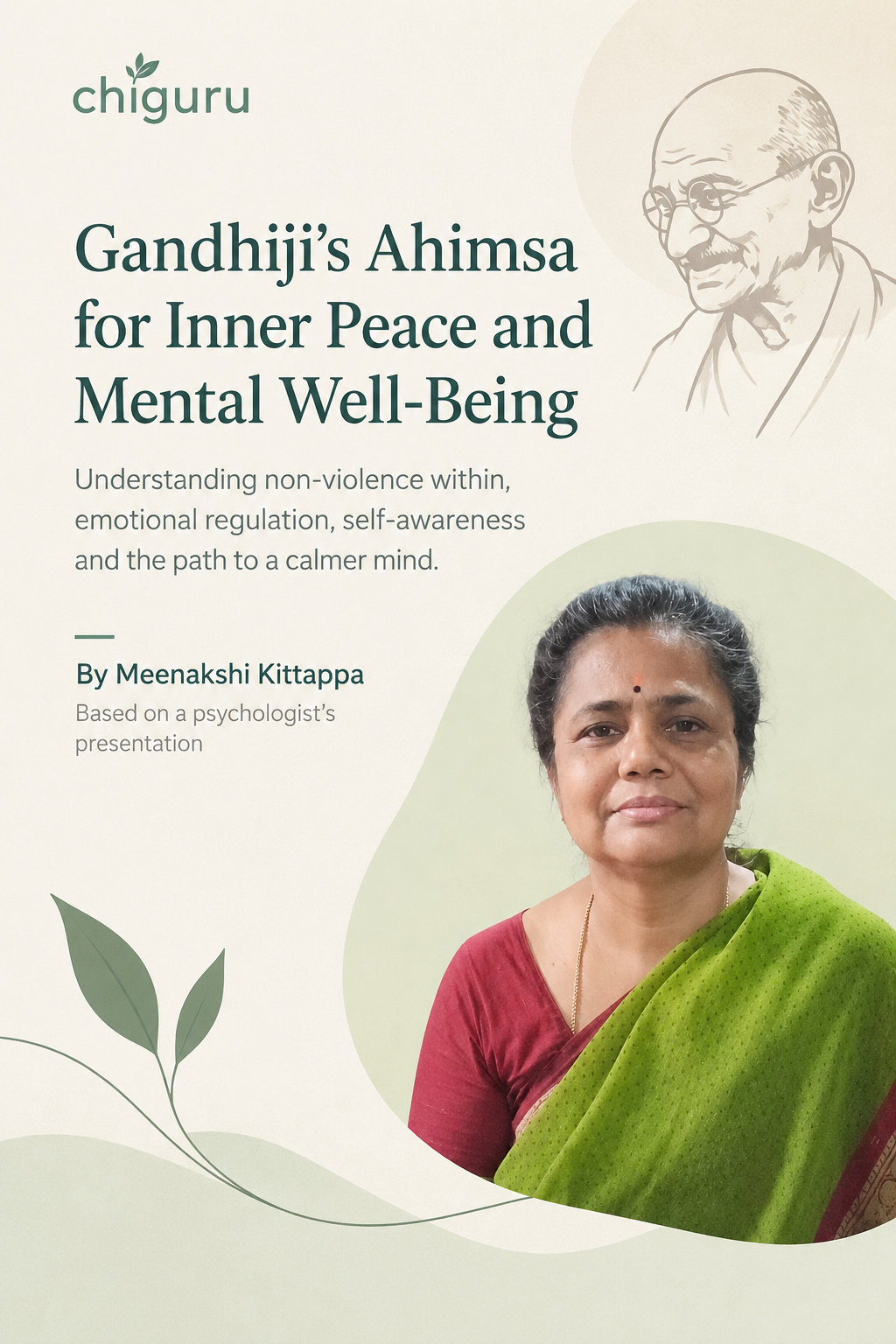
Understanding non-violence within the mind, emotional regulation, self-awareness, and psychological autonomy
Author: Meenakshi Kittappa
Introduction: Ahimsa Begins Within the Mind
Mahatma Gandhi’s concept of Ahimsa, or non-violence, extends beyond the absence of physical harm. It can also be understood as an inner alignment of thought, speech, and action. Before non-violence is expressed towards others in society, it begins within the mind.
Gandhiji’s philosophy offers a framework for reflecting on inner peace, emotional regulation, cognitive clarity, and resilience. It encourages individuals to examine not only how they behave towards others, but also how they respond to their own thoughts, mistakes, emotions, and expectations.
Harsh self-criticism, impatience, shame, perfectionism, anger, resentment, and fear can contribute to inner tension. When these patterns remain unexamined, they may influence how individuals perceive themselves, respond to others, and make decisions.
Practising Ahimsa internally involves developing self-awareness, replacing self-punishment with self-compassion, and learning to respond thoughtfully rather than react immediately. It also involves recognising the importance of truth, self-control, courage, and personal values.
Through the principles of Ahimsa, Swaraj, Satya, and Nirbhayata, Gandhian philosophy provides a way to reflect on the relationship between inner discipline and mental well-being.
1. Understanding Ahimsa: Inner Alignment of Thought, Speech, and Action
Ahimsa is commonly understood as non-violence. In the framework presented here, it begins with the alignment of three dimensions: thought, speech, and action.
This understanding invites individuals to examine whether their internal thoughts, spoken words, and outward behaviour reflect the values they wish to practise.
Thought: Becoming Aware of Inner Speech
The mind can become a place of self-criticism and judgement. People may respond to mistakes with impatience, shame, or unrealistic expectations. They may repeatedly revisit situations, judge themselves harshly, or feel that their actions are never good enough.
Internal Ahimsa encourages a different response. Rather than punishing oneself for every mistake, an individual can practise compassionate self-understanding and constructive self-acceptance.
This does not mean ignoring mistakes or avoiding responsibility. Instead, it means examining them without turning the process into continuous self-punishment.
Speech: Practising Calm and Honest Communication
Non-violence in speech involves being aware of how words affect oneself and others. Harsh words, defensive gossip, and passive-aggressive remarks can create tension and weaken relational trust.
Vacha Ahimsa encourages calm honesty. It asks individuals to communicate with awareness rather than allowing anger or defensiveness to determine their words.
Action: Aligning Behaviour with Values
Non-violence in action involves choosing behaviours that support safety and peace. Karmana Ahimsa encourages individuals to examine whether their habits and actions reflect their values.
When thought, speech, and action are aligned, individuals can work towards greater personal integrity and a more mindful approach to everyday situations.
2. Internal Non-Violence: Recognising Self-Directed Aggression
Violence is not always expressed through outward behaviour. It may also appear in subtle internal patterns, including harsh self-criticism, impatience, uncharitable judgement, shame, perfectionism, and compulsive attachment.
These patterns can create an internal environment in which a person repeatedly judges or punishes themselves.
Replacing Self-Punishment with Self-Compassion
Internal Ahimsa encourages individuals to notice hostile thought patterns and replace them with compassionate understanding.
For example, after making a mistake, a person might repeatedly criticise themselves instead of reflecting on what happened. The practice of self-compassion offers an alternative: acknowledge the mistake, understand the response, and consider how to act constructively.
The emphasis is on moving away from hostile internal dialogue towards a more accepting and thoughtful relationship with oneself.
Recognising Shame and Perfectionism
Unexamined perfectionist demands can contribute to inner tension. When individuals expect themselves to meet rigid standards, even ordinary mistakes may become reasons for self-punishment.
Self-awareness helps bring these demands into focus. By recognising perfectionist thinking, people can begin to examine whether their expectations are constructive or are creating unnecessary internal conflict.
Understanding Aparigraha
Aparigraha is presented as a principle of releasing maladaptive desires and compulsive attachments. The presentation also refers to Aswad in this context.
The underlying reflection is that internal compulsion and excessive attachment can contribute to anxiety and chronic dissatisfaction. Recognising these patterns encourages individuals to examine their desires, attachments, and expectations rather than allowing them to govern every response.
3. Self-Awareness: Recognising the Patterns Behind Inner Tension
Self-awareness is an important step towards practising internal non-violence. Before individuals can change a pattern, they need to recognise when it occurs and what it looks like in everyday life.
The presentation proposes a practical self-observation exercise focused on three areas.
Exercise 1: Track Harsh Criticism
Ask:
- While evaluating my actions, am I engaging in harsh self-criticism or impatience?
- Do I respond to mistakes with constructive reflection or self-punishment?
Practice: Track three incidences in a day when harsh self-criticism or impatience appears.
Exercise 2: Identify Cognitive Traps
Ask:
- Is my acceptance of mistakes trapped in repetitive thinking?
- Am I experiencing shame or self-punishment when something does not go as expected?
Practice: Track three events in a day in which these patterns occur.
Exercise 3: Observe Inner Tension
Ask:
- Are unexamined perfectionist demands creating continuous tension?
- Are inner compulsions or unresolved resentments affecting my peace of mind?
Practice: Track three different events in a day that contribute to inner tension or self-directed aggression.
The purpose of these exercises is to make internal patterns more visible. Rather than allowing reactions to remain unnoticed, individuals can begin to observe them and reflect on their responses.
4. Emotional Regulation: Moving Beyond Reactive Responses
Emotional regulation involves recognising emotions and responding to them with awareness. The presentation highlights anger, grudges, resentment, non-reactivity, deliberate forgiveness, and fearlessness as important parts of this process.
Recognising Subtle Himsa
Himsa refers to harm or violence. The presentation describes harbouring anger, grudges, and resentment as subtle forms of Himsa because these experiences may affect the person carrying them first.
When resentment remains unexamined, it can keep an individual focused on conflict and defensive reactions.
Recognising this pattern does not require denying anger or pretending that a difficult experience did not occur. It begins with acknowledging the emotion honestly and understanding how it influences one's responses.
Practising Non-Reactivity
Non-reactivity involves creating space between an emotional trigger and the response that follows.
Rather than reacting immediately to a difficult expression, communication, or body language, individuals can pause and consider how they want to respond.
This deliberate pause can help reduce escalation and support a more thoughtful response.
Understanding Forgiveness Without Suppression
The presentation connects deliberate forgiveness and non-reactivity with emotional equilibrium and active love.
Forgiveness, in this context, should not be confused with pretending that anger does not exist. The presentation distinguishes active love from passive suppression, highlighting the importance of acknowledging strong emotions honestly.
The aim is to move towards a response that reflects awareness and intentionality rather than allowing resentment or aggression to dictate behaviour.
5. Nirbhayata: The Role of Fearlessness
Nirbhayata means fearlessness. Within the framework of Ahimsa, it represents the ability to face difficult realities and strong emotions honestly.
The presentation emphasises that non-violence is not the same as repressed anger or cowardice born of fear. True non-violence requires the courage to acknowledge emotions rather than hide or suppress them.
This involves recognising aggressive impulses and directing them towards assertive, morally calm responses.
Identifying Sources of Fear
The presentation encourages individuals to reflect on the causes of their fear.
Consider the following questions:
- What aspects of a relationship create fear?
- What concerns about the future create fear?
- How does the possibility of losing self-respect influence my responses?
Writing down these reflections can help individuals become more aware of the situations that affect their emotional reactions.
Understanding Immediate Reactivity
Individuals may react immediately to particular triggers, including:
- Expressions from others
- Communication from others
- Body language that feels disrespectful or ill-treating
Recognising these triggers can help create an opportunity to pause and choose a response rather than reacting automatically.
Fearlessness, therefore, is not about denying fear. It is about acknowledging difficult emotions and responding with greater awareness, courage, and self-control.
6. Swaraj: Self-Rule and Psychological Autonomy
Swaraj is presented as self-rule and psychological autonomy. It represents self-sovereignty over one's impulses and thoughts.
The principle encourages individuals to develop greater awareness of their internal responses instead of allowing external provocations to determine their emotional state.
Developing Inner Sovereignty
Inner sovereignty involves recognising that although external events cannot always be controlled, one's response to them can be examined and guided by personal values.
The presentation encourages individuals to cultivate self-control over impulses, greed, and physical attachments. This practice supports the broader goal of psychological independence.
Strengthening the Locus of Control
The presentation connects mental well-being with internal control: refusing to allow external provocations to dictate emotional states or disturb psychological independence.
This does not mean that individuals can control every circumstance or emotion. Instead, it directs attention towards the choices and responses that remain within their influence.
Living According to Core Values
When Satya (truth) and Ahimsa guide actions, behaviour can become more aligned with personal values.
Living authentically is presented as a way to reduce the tension that arises when thoughts, beliefs, and behaviour are not aligned.
Swaraj therefore brings together self-awareness, self-control, personal values, and deliberate action.
7. Practical Ways to Cultivate Ahimsa for Inner Peace
The presentation identifies three practical approaches for bringing these principles into everyday life.
Cognitive Self-Audit
Actively monitor inner speech. Notice hostile self-talk, harsh self-criticism, and perfectionist demands when they appear.
Once recognised, deliberately replace these patterns with compassionate understanding.
A cognitive self-audit encourages individuals to examine how they speak to themselves and whether their internal dialogue supports clarity or creates additional tension.
Mindful Respite
Practise taking a purposeful pause when triggered.
Creating a gap between provocation and reaction provides an opportunity to observe the situation and respond deliberately. Instead of allowing an immediate reaction to determine behaviour, the individual can return to a more considered response.
This practice supports the presentation's emphasis on emotional regulation and non-reactivity.
Inner Sovereignty
Cultivate Swaraj by becoming more conscious of how external events influence the mind.
Rather than depending entirely on external approval, individuals can centre their responses on core personal values. This involves examining impulses, practising self-control, and choosing actions that align with personal principles.
Together, these practices translate the philosophical idea of Ahimsa into a daily process of observation, reflection, and intentional response.
8. Gandhian Principles and Contemporary Psychological Concepts
The presentation draws conceptual connections between Gandhian values, Cognitive Behavioural Therapy (CBT), and mindfulness.
These connections are presented as parallels between philosophical principles and approaches to understanding thoughts, emotions, and behaviour.
Satya and Cognitive Reality
Satya, or truth, is connected with examining internal beliefs and cognitive distortions.
The presentation draws a parallel between holding firmly to truth and the process of cognitive restructuring in CBT. Both are framed around examining inaccurate or unhelpful thinking and bringing thoughts and behaviour into closer alignment with reality and personal values.
Ahimsa and Mindfulness
Ahimsa is presented as active compassion and non-judgement.
Its internal application involves observing emotional triggers without harsh judgement and developing a more compassionate understanding of oneself.
This is connected with mindfulness, particularly the practice of noticing internal experiences without immediately reacting to them.
Swaraj and Emotional Regulation
Swaraj is connected with self-rule and autonomy. Rather than reacting reflexively to external provocations, individuals are encouraged to practise intentional pauses and develop greater control over their behavioural responses.
These conceptual connections highlight how Gandhian principles can be used as a framework for reflecting on self-awareness, compassion, and emotional regulation.
9. Inner Purity, Moral Strength, and Universal Peace
The presentation also connects Ahimsa with values drawn from religion and epics. These concepts form a broader framework for inner discipline, personal responsibility, and harmony.
- Dharma and Karma Yoga: Righteousness, unselfish action, and the determination to act without seeking personal benefit.
- Yajna: Sacrifice as a determination to cleanse oneself and become fit for purposeful living.
- Shaucha: Internal purity and the determination to remove internal “dust.”
- Atman and Viryam: Courageous identity, strength, autonomy, and spiritual resilience.
- Svadharma: The determination to stand firm in one's individuality.
- Moksha: The determination to become free from domination and illusion.
- Dhriti: Inner strength and fortitude when facing difficult trials.
- Samatvam: Equality as a principle of harmony and enlightenment.
- Kshama: Tolerance that helps cultivate trust across communities.
- Shanti: Universal peace and the cultivation of humanity and inner calm.
Together, these concepts extend the discussion beyond individual emotional responses to a broader understanding of values, self-discipline, trust, and peaceful coexistence.
Conclusion: Practising Ahimsa for Mental Peace
Gandhiji's philosophy of Ahimsa offers a framework for reflecting on the relationship between inner thoughts, speech, actions, and emotional responses.
Practising internal non-violence begins with recognising self-directed aggression, harsh criticism, perfectionism, resentment, and fear. Self-awareness makes these patterns easier to observe, while mindful pauses and compassionate self-understanding provide a way to respond more deliberately.
The principles of Manasa Ahimsa, Vacha Ahimsa, Karmana Ahimsa, and Nirbhayata bring this philosophy into everyday life through non-violence of the mind, non-violence in speech, non-violence in action, and fearless emotional balance.
Swaraj encourages self-rule and psychological autonomy, while Satya emphasises truth and alignment with personal values. The wider principles of Dharma, Karma Yoga, Shaucha, Dhriti, Kshama, and Shanti further highlight the importance of integrity, fortitude, tolerance, and universal peace.
The central message is to cultivate self-affection, clarity of thought, mindful action, compassion, and self-control. By observing internal patterns and making deliberate choices, individuals can work towards a more thoughtful relationship with themselves and others.
Ahimsa, in this understanding, is not merely the absence of outward violence. It is an ongoing practice of bringing thought, speech, and action into greater alignment with compassion, truth, courage, and inner peace.
Reflections from Gandhiji’s Philosophy
The presentation includes the following quotations attributed to Mahatma Gandhi:
- “Ahimsa is the first article of my faith and last article of creed.”
- “Ahimsa and love are one and the same thing.”
- “Ahimsa is my God and truth is my God.”
These quotations reflect the presentation's emphasis on the connection between non-violence, love, and truth.
About the Author
Meenakshi Kittappa
Connect with Meenakshi Kittappa on LinkedIn: https://www.linkedin.com/in/meenakshi-kittappa-b184a8298/
This article is based on Meenakshi Kittappa’s presentation, “Gandhiji’s Ahimsha for Internal Peace to Focus Mental Health.”