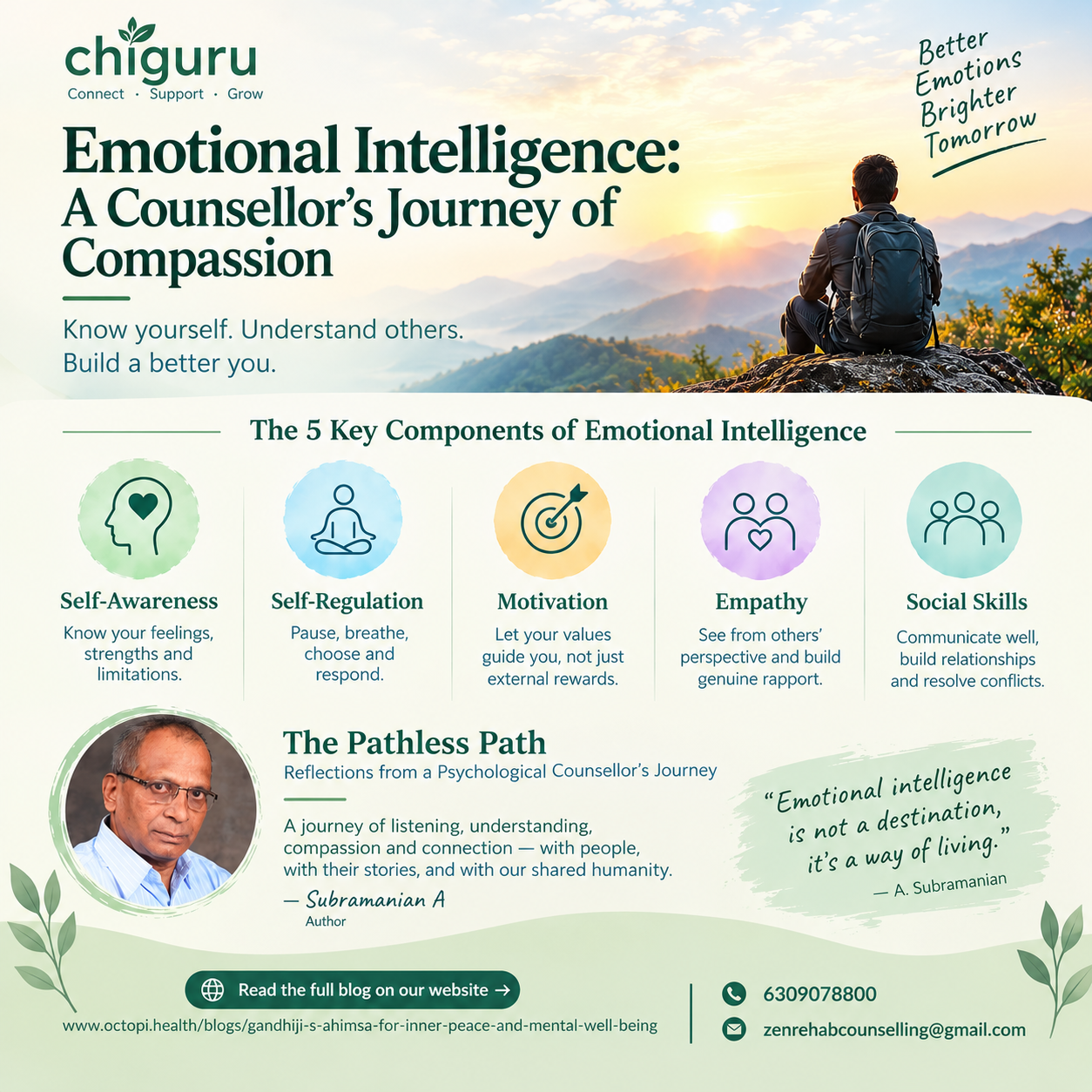
Know Yourself. Understand Others. Build a Better You.
Emotional intelligence is an essential part of understanding ourselves, building meaningful relationships, and responding to life's challenges with greater awareness. It helps us recognise our emotions, manage our reactions, understand the feelings of others, and communicate more effectively.
But emotional intelligence is not merely a concept to learn. It is a practice that develops through everyday experiences, personal reflection, and our interactions with others.
For a psychological counsellor, this understanding can take on a deeper meaning. Listening to people from different backgrounds, witnessing their emotional struggles, and supporting them through difficult experiences can become a journey of personal transformation as well as professional service.
In this article, Subramanian A reflects on the five key components of emotional intelligence and shares insights from the journey of a psychological counsellor—a path shaped by compassion, patience, understanding, and a deeper connection with humanity.
Understanding Emotional Intelligence
Emotional intelligence, commonly known as EQ, is the ability to understand, use, and manage our emotions in positive ways.
It helps us relieve stress, communicate effectively, empathise with others, overcome challenges, and defuse conflict.
Emotional intelligence encourages us to become more aware of what happens within us and how our emotional responses influence the people around us. By developing this awareness, we can work towards healthier relationships, thoughtful decisions, and a better understanding of ourselves.
The five key components of emotional intelligence are self-awareness, self-regulation, motivation, empathy, and social skills.
1. Self-Awareness: Know Yourself
Self-awareness begins with recognising our feelings, strengths, and limitations. It involves understanding how emotions influence our thoughts, behaviour, and decisions.
When we become aware of what we feel and why we respond in particular ways, we create an opportunity to understand ourselves more clearly.
Without self-awareness, emotions can influence our reactions without our fully recognising what is happening. With greater awareness, we can pause, reflect, and make more considered choices.
How to practise self-awareness
- Pause and check in with your feelings. Take a moment to identify what you are experiencing.
- Keep a journal. Record your feelings, experiences, and reactions to recognise patterns over time.
- Seek feedback from trusted people. Listening to perspectives you respect can help you understand yourself more clearly.
Self-awareness is the starting point for personal growth. Before we can understand others deeply, we need to become willing to understand ourselves.
2. Self-Regulation: Pause, Breathe, Choose, Respond
Self-regulation is the ability to manage our emotions, remain calm under pressure, and respond thoughtfully instead of reacting immediately.
Difficult situations can bring frustration, anger, disappointment, or anxiety. While emotions are a natural part of human experience, the way we respond to them can influence the outcome of a situation.
Self-regulation encourages us to create a pause between what happens and how we respond.
How to practise self-regulation
- Practise deep breathing. Give yourself a moment to slow down and regain composure.
- Create a pause before reacting. Avoid responding immediately when emotions are intense.
- Focus on what you can control. Direct your attention towards your own choices and actions rather than circumstances beyond your influence.
The guiding principle is simple: Pause. Breathe. Choose. Respond.
A thoughtful response does not require us to ignore our emotions. It requires us to recognise them and decide how we want to act.
3. Motivation: Let Your Values Guide You
Motivation helps us remain committed even when circumstances become difficult. It encourages us to continue working towards meaningful goals and to find purpose beyond external rewards.
Personal motivation can come from our values, aspirations, and understanding of what matters most to us.
Progress is not always immediate. There may be setbacks, uncertainty, and moments when the journey feels challenging. During these times, reconnecting with our purpose can help us continue moving forward.
How to strengthen motivation
- Reconnect with your purpose. Reflect on why your goals matter to you.
- Set meaningful goals. Choose goals that align with your values and priorities.
- Celebrate small progress. Recognise the steps you take, even when the final destination is still far away.
Motivation is not about feeling inspired every moment. It is about continuing to take meaningful steps, including during challenging periods.
4. Empathy: Understand Others
Empathy is the ability to recognise what others may be feeling and consider situations from their perspective.
It allows us to move beyond our immediate assumptions and become more attentive to another person's experience.
People may respond differently to similar situations because their experiences, circumstances, and emotional needs are different. Empathy encourages us to listen before judging and to seek understanding before offering conclusions.
How to practise empathy
- Listen without judgement. Give others the space to express themselves without rushing to criticise or correct them.
- Try to see the situation from their perspective. Consider what the experience might mean to the other person.
- Show genuine care and interest. Communicate through attentive listening and thoughtful responses.
Empathy is especially meaningful in relationships where people may struggle to express their feelings. Sometimes, allowing someone to feel heard is an important step towards building trust and understanding.
5. Social Skills: Build Meaningful Relationships
Social skills involve communicating clearly, building positive relationships, working effectively in teams, and resolving conflicts constructively.
Good communication is not limited to speaking confidently. It also involves listening carefully, respecting differences, and remaining open to perspectives that may differ from our own.
When people communicate with mutual respect, they create opportunities for collaboration and stronger relationships.
How to strengthen social skills
- Be a good listener and express yourself clearly. Make space for others while communicating your own thoughts honestly.
- Show respect and remain open to different views. Recognise that people may understand situations differently.
- Work towards win-win solutions. Look for ways to address disagreements that consider the needs of everyone involved.
Social skills bring the other components of emotional intelligence into our daily interactions. Self-awareness helps us understand our reactions, self-regulation helps us manage them, motivation keeps us focused, and empathy helps us understand others.
Together, these abilities can support more thoughtful communication and stronger relationships.
The Pathless Path: The Journey of a Psychological Counsellor
By Subramanian A
Life has a remarkable way of rewarding those who seek meaning with sincerity. I consider myself fortunate to be among those who have found meaning through their work and experiences.
Working as a counsellor and therapist, and engaging with clients experiencing mental health challenges, has revealed the unseen realities of human suffering. Behind every client is a person carrying an experience, a concern, or an emotional struggle that may not be visible to the outside world.
There is often an unhealed part of a person that carries emotional pain and suffering. Understanding this requires more than looking at the circumstances from the outside. It requires patience, compassion, and a willingness to listen.
Every Person Carries a Different Story
Throughout my journey, I have encountered people from different stages of life and backgrounds.
A young student may feel overwhelmed by anxiety. An elderly person may be struggling with loneliness. A transgender person may be seeking empowerment. A couple may be experiencing difficulties in their relationship.
Each experience is different, and each person brings a story that deserves to be heard.
Mental health challenges do not discriminate by age, gender, or background. Emotional suffering can touch people in different circumstances, and no two individuals necessarily experience or respond to their difficulties in the same way.
These encounters have deepened my understanding of human experiences. They have reminded me of the importance of approaching each person with openness rather than assumptions.
A Journey of Compassion and Patience
Working with people through their emotional struggles has shaped the way I understand compassion.
It has encouraged me to become more patient, more understanding, and more deeply connected with humanity.
Every interaction offers an opportunity to listen, reflect, and appreciate the complexity of another person's experience. A counsellor's journey is not only about understanding the struggles that people bring into a session. It is also about recognising the humanity behind those struggles.
This journey has taught me that compassion requires us to look beyond appearances and circumstances. It invites us to approach people with dignity and to remember that their experiences may contain dimensions we cannot immediately see.
Choosing Peace Instead of Hurt or Anger
One of the personal reflections from this journey concerns the way I respond when someone speaks harshly to me.
Today, when someone speaks harshly, my first thought is no longer to feel hurt or angry. Instead, I silently pray:
“May you find peace within yourself.”
This response reflects a shift in perspective. Rather than allowing another person's words to determine my immediate emotional response, I try to approach the moment with greater understanding.
It is a reminder that the way people communicate may exist alongside struggles or experiences that we do not fully know. Responding with compassion does not mean that every behaviour must be accepted or that personal boundaries are unimportant. It means making room for a thoughtful response instead of allowing hurt or anger to guide every interaction.
This reflection also connects with emotional intelligence. Self-awareness helps us recognise when we feel hurt. Self-regulation allows us to pause before responding. Empathy invites us to consider another person's perspective, while social skills help us communicate with greater care.
The practice is not always easy, but it offers an opportunity to choose how we want to respond.
Gratitude for the People Who Have Shaped the Journey
I remain deeply grateful to the thousands of clients who have taught me meaningful lessons about life and its values.
Their experiences have contributed to a journey of service, compassion, and transformation.
Each person has a story, and every interaction has reinforced the importance of approaching human experiences with humility and understanding. The journey has helped me become more compassionate, more patient, and more connected with humanity.
For me, the path of a psychological counsellor is not simply a professional role. It is an ongoing journey of learning from people, reflecting on experiences, and recognising the value of compassionate service.
The path may not always be clearly marked, but the values of service, compassion, and transformation continue to give it meaning.
How Emotional Intelligence Connects with the Counsellor's Journey
The five components of emotional intelligence offer a useful way to reflect on the experiences shared in The Pathless Path.
Self-awareness encourages us to recognise our feelings and understand our reactions. In the counselling journey, this means noticing personal responses rather than allowing them to remain unexamined.
Self-regulation reminds us that we can pause before responding. Choosing not to react immediately to harsh words reflects the effort to respond thoughtfully rather than impulsively.
Motivation helps us remain connected to our purpose. The commitment to service and the meaning found in helping others can guide a person through difficult experiences.
Empathy encourages us to see beyond the surface of another person's behaviour. Listening to people from different backgrounds requires an openness to experiences that may differ from our own.
Social skills support respectful communication and the development of meaningful connections. They help us listen carefully, express ourselves clearly, and navigate differences with greater understanding.
These components are not isolated abilities. They work together in everyday life, shaping how we understand ourselves, interact with others, and respond to challenges.
The counsellor's journey described here offers a personal reflection on how these values can become part of a way of living.
Emotional Intelligence Is a Way of Living
Emotional intelligence is not a destination that we reach once and for all. It is an ongoing practice of knowing ourselves, understanding others, and working towards becoming better versions of ourselves.
There will be moments when we react too quickly, misunderstand another person, or struggle to manage our emotions. What matters is our willingness to reflect, recognise these experiences, and continue learning.
Self-awareness helps us recognise what is happening within us. Self-regulation gives us space to choose our responses. Motivation keeps us connected to meaningful goals. Empathy helps us appreciate other people's experiences, and social skills enable us to build stronger relationships.
The reflections in The Pathless Path add a personal dimension to these ideas. A journey shaped by counselling, human experiences, and gratitude can become an opportunity to deepen compassion and strengthen our connection with others.
As the closing message of the emotional intelligence poster reminds us:
“Emotional intelligence is not a destination, it’s a way of living.” — A. Subramanian
The journey continues through everyday choices: listening before judging, pausing before reacting, respecting different perspectives, and responding to others with care.
Ultimately, emotional intelligence is about bringing greater awareness and intention into the way we live and relate to people. It is a continuing journey of self-understanding, compassion, and personal growth.
About the Author
Subramanian A
Subramanian A shares his reflections on emotional intelligence and the journey of a psychological counsellor, highlighting the importance of self-awareness, empathy, compassion, and personal growth.
Through his reflections, he emphasises how meaningful human connections and thoughtful responses can contribute to a more compassionate approach to life.
Contact Subramanian A
- Phone: +91 63090 78800
- Email: zenrehabcounselling@gmail.com
Connect for enquiries and counselling-related information.