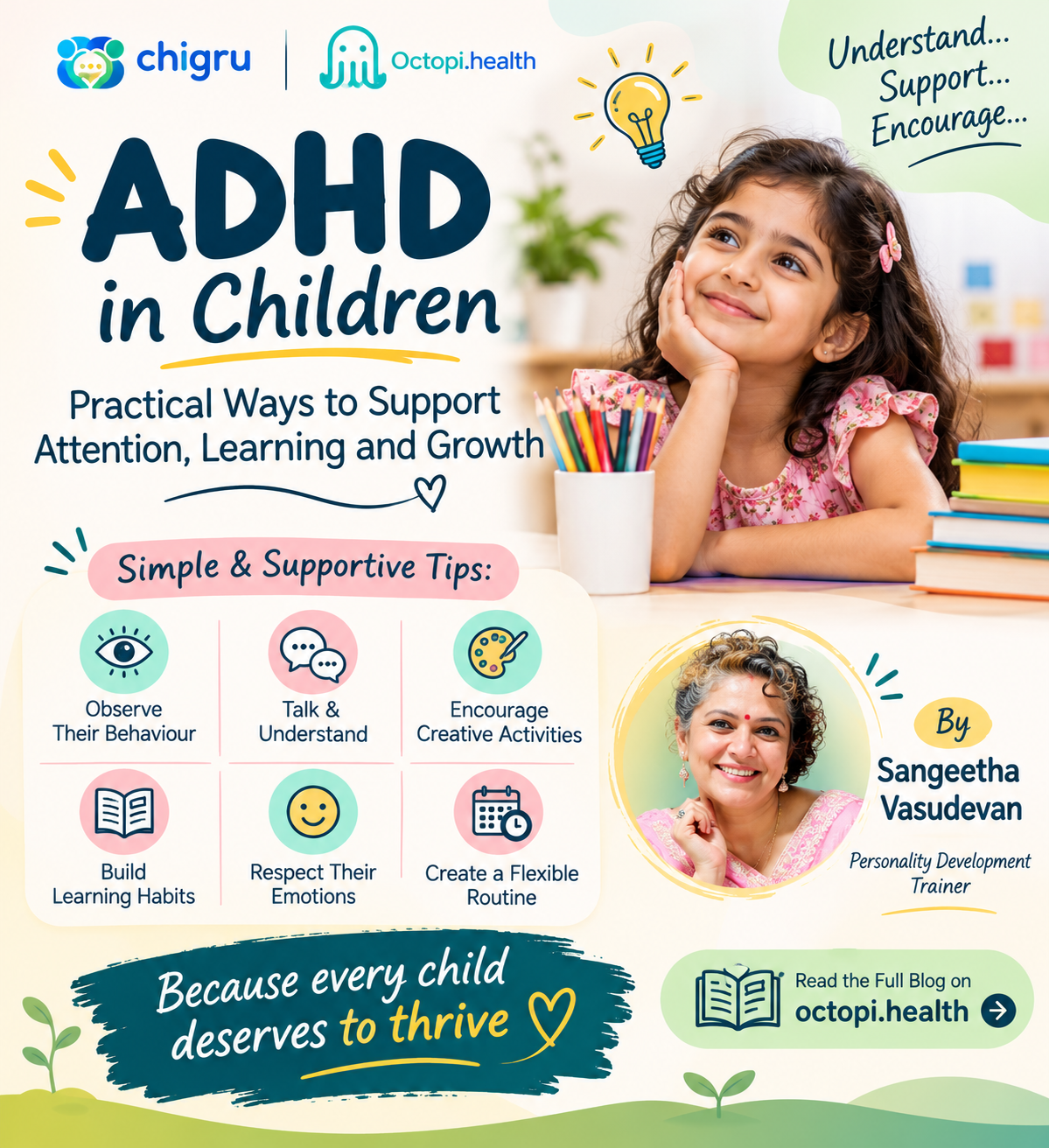
Every child has a different way of thinking, learning, communicating, and responding to the world around them. Some children may find it difficult to remain focused on an activity, follow instructions, organise their schoolwork, or express their thoughts. Understanding these differences is an important step towards creating a supportive learning environment.
Attention-Deficit/Hyperactivity Disorder (ADHD) is a neurodevelopmental condition that can affect attention, activity levels, and impulse control. However, not every child who is restless, distracted, or uninterested in a particular activity has ADHD. These behaviours can have different explanations, and an assessment by a qualified healthcare professional is necessary to determine whether a child has ADHD.
Supporting a child begins with observing their individual needs, understanding their interests, and creating opportunities for them to participate in activities at a comfortable pace.
In this article, Sangeetha Vasudevan, Personality Development Trainer, shares practical activity-based ideas that can encourage children's participation, communication, observation, and learning.
Understanding the Child Before Planning Activities
Before introducing an activity, it is useful to understand how the child responds to different situations.
Children may show different levels of interest depending on the activity, environment, instructions, and materials involved. One child may enjoy drawing, while another may prefer reading, building objects, talking, or working with toys.
Rather than expecting every child to respond in the same way, parents, trainers, and caregivers can begin by understanding the child's preferences.
The following approaches offer ways to observe and engage with children during learning sessions.
1. Observe the Child During Activities
Observation can help adults understand how a child approaches an activity and what captures their interest.
During a face-to-face session, observe the child's:
- Body movements and posture.
- Facial expressions.
- Eye contact, while respecting individual comfort and communication differences.
- Interest in the activity or project.
- Responses to instructions.
- Restlessness or changes in attention.
- Communication and interaction.
A short observation period of approximately 15–20 minutes may provide an opportunity to notice how the child engages with a particular activity.
For example, observe the child while drawing, playing, reading, or completing a small project. Notice which parts of the activity attract their attention and when they appear to lose interest.
Why it matters: Observation helps adults understand the child's responses instead of making assumptions based on a single behaviour.
It is important to remember that observation during a training session is not a diagnostic assessment. ADHD cannot be identified through eye contact, facial expressions, restlessness, or one short activity alone.
2. Talk to the Child and Understand Their Interests
Communication is an important part of understanding a child's needs.
Before beginning an activity, spend a few minutes talking to the child. Ask about their interests, favourite subjects, hobbies, activities, and things they enjoy doing.
Instead of asking only questions that require a yes-or-no answer, introduce open-ended questions such as:
- What do you enjoy doing in your free time?
- Why do you like this particular activity?
- How did you complete this project?
- Which part did you find interesting?
- What happened when you tried it?
- What would you like to learn next?
Open-ended questions allow children to explain their thoughts in their own words. Closed-ended questions can also be useful when a specific detail needs clarification.
Allow the child enough time to respond. Avoid interrupting or correcting every sentence.
Practical approach: Begin a session with a short conversation of around 5–8 minutes. Explain the activity in simple language and check whether the child understands what is expected.
3. Encourage Reading, Drawing and Creative Expression
Children can express their understanding in different ways. Some may prefer explaining an idea verbally, while others may communicate better through drawing or practical activities.
A useful approach is to combine reading with creative expression.
For example:
- Give the child a short paragraph to read.
- Ask them to identify the main idea.
- Invite them to draw something related to the paragraph.
- Ask them to explain their drawing.
- Encourage them to summarise what they understood in their own words.
This process gives the child an opportunity to engage with information in more than one way.
Encourage Imaginative Drawing
A child can also be invited to draw an imaginary object or animal and explain its features.
For example, ask the child to imagine a dog with two horns and a feather.
The child might explain that the horns are used for a particular purpose in their imaginary story and that the feather helps the dog fly.
The purpose is not to judge whether the drawing is realistic. It is to encourage imagination, description, and the ability to explain an idea.
4. Practise Summarising and Identifying Important Information
Reading a paragraph and explaining it in fewer words can be a useful learning activity.
Give the child a short paragraph and ask them to identify the most important information. Encourage them to remove unnecessary words and replace longer expressions with simpler words where appropriate.
For example, after reading a paragraph, ask:
- What is this paragraph mainly about?
- Which sentence explains the main idea?
- Which words are important?
- Can you explain this in two or three sentences?
This activity can encourage comprehension, vocabulary development, and the ability to organise information.
The aim should be understanding rather than completing the task as quickly as possible.
5. Use a Stopwatch for Short Reading Activities
A stopwatch can be introduced as a simple way to make a reading activity interactive.
The child can press the start and stop buttons while reading a selected passage. In another variation, the trainer can operate the stopwatch while the child reads.
The activity can be adapted by using short reading periods and allowing breaks when needed.
How to use it:
- Select a short and age-appropriate passage.
- Explain the activity before beginning.
- Let the child operate the stopwatch if they are interested.
- Observe their comfort and engagement.
- Discuss what they understood after reading.
A stopwatch should not become a source of pressure or a measure of the child's ability. Reading speed alone does not determine comprehension, attention, or learning ability.
6. Explore Different Perspectives Through Drawing
Drawing an object from different angles can be an engaging activity for children who enjoy visual and practical tasks.
Choose a familiar object and place it where the child can observe it from different sides.
Ask the child to draw:
- Left-hand view.
- Right-hand view.
- Front view.
- Top view.
- Another side or perspective view.
The child can first observe the object and then attempt to draw it from memory.
For a variation, allow the child to look at the object for a short period, put it aside, and draw what they remember.
This activity can encourage observation, visual memory, spatial understanding, and creative thinking.
Keep the task enjoyable. If the child finds it difficult, allow them to look at the object again rather than treating mistakes as failures.
7. Introduce Simple Sound and Listening Activities
Listening activities can provide opportunities for children to notice differences in sound, follow instructions, and participate in a structured task.
One activity suggested in the training material involves five tumblers containing different amounts of water:
- First tumbler: half-filled.
- Second tumbler: three-fourths filled.
- Third tumbler: one-fourth filled.
- Fourth tumbler: completely filled.
- Fifth tumbler: empty.
The original activity proposes making a soft "shh" sound near the tumblers and following a clockwise and anti-clockwise sequence.
This can be adapted into a simple sound-awareness exercise by allowing the child to listen to sounds produced safely using the tumblers, compare the sounds, and describe what they notice.
Important: The specific sound exercise described here has not been established as an ADHD treatment or a proven way to improve concentration. Keep the activity voluntary, comfortable, and supervised. Do not require repetitive mouth-to-container contact or prolonged breath-holding.
The purpose of such an activity should be exploration and participation, not a clinical outcome.
8. Encourage Conversation and Social Interaction
Children benefit from opportunities to communicate their interests and exchange ideas with others.
A trainer or parent can encourage the child to start a conversation with a friend about a topic they both enjoy.
Afterwards, invite the child to describe the conversation:
- What did you talk about?
- What did your friend say?
- Which part did you enjoy?
- Did you agree with your friend's opinion?
- How did you feel during the conversation?
These questions can help children practise expressing their thoughts and reflecting on social interactions.
It is equally important to respect a child's comfort level. Some children may need more time or support before participating in group conversations.
9. Help Children Recognise and Express Their Emotions
Understanding emotions is an important part of communication.
A drawing activity can help children explore how different feelings appear on their faces.
Ask the child to draw facial expressions that represent emotions such as:
- Happiness.
- Sadness.
- Anger.
- Excitement.
- Confusion.
- Disappointment.
The child can explain what situations might make them feel that way.
For example, ask how they feel when their opinion is accepted or rejected. Encourage them to describe their feelings without judging the response.
Parents and trainers can also introduce simple words to describe emotions and situations, such as:
- Excitement.
- Boredom.
- Frustration.
- Shouting.
- Screaming.
- Manipulation.
Explain these words using age-appropriate examples and everyday situations.
Children should be encouraged to express their needs clearly and respectfully. This can be practised through simple sentences such as:
"I feel upset because I wanted to finish my activity."
"I need some time before I continue."
"I do not agree, and I would like to explain why."
The aim is to help children communicate their feelings without hurting themselves or others.
10. Practise Finding Information in Books
A simple book-searching activity can encourage children to locate specific information.
Give the child a textbook or reading material and provide a set of instructions.
For example:
- Find page number 45.
- Go to paragraph number 4.
- Locate line number 6.
- Identify the fourth word in that line.
You can also ask the child to count how many times a particular word appears in a paragraph.
For example, ask the child to identify the word "teeth" in a selected passage.
These activities can make reading more interactive and encourage children to practise following instructions and locating information.
Adjust the difficulty according to the child's reading level. Avoid creating unnecessary pressure through speed-based challenges.
11. Understand the Child's Subject Preferences
Children may have different levels of interest in different school subjects.
One child may enjoy Science but find History difficult. Another may prefer Mathematics and feel less interested in reading.
Instead of immediately labelling a child as lazy or uninterested, explore the reason behind the preference.
For example, if a child says, "I hate History," ask:
- What do you find difficult about it?
- Is it remembering dates?
- Do you find the lessons difficult to understand?
- Is there a particular chapter you enjoy?
- What would make the subject more interesting?
There may be a specific difficulty behind the child's response.
A child who dislikes memorising dates may benefit from timelines, stories, visual notes, or other ways of organising information.
The distinction between disliking a subject and finding a particular learning method difficult is worth exploring.
12. Help Children Organise Their Books and Daily Activities
Organising books and learning materials can be introduced as a small activity before a session.
Ask the child to arrange their books according to their preferred order or the task they need to complete.
You can also invite the child to explain their choices.
For example:
- Which subject would you like to begin with?
- Which subject feels more difficult today?
- Which activity would you like to complete next?
This gives the child an opportunity to participate in planning.
A timetable can also be developed through discussion with the child and, where appropriate, their parents or caregivers.
For example:
"I plan to practise yoga from 6:30 AM to 7:00 AM on Tuesday and Friday."
The same approach can be used to plan music classes, dance, sports, hobbies, reading, or other activities.
Avoid creating a timetable in a hurry. Consider the child's interests, energy levels, school schedule, and need for rest.
A realistic and flexible plan is more useful than an overly demanding schedule.
13. Include Short Breaks and Comfortable Learning Sessions
Long activities may become difficult for some children to manage. Breaking a task into smaller sections can make it easier to approach.
For example, a reading session can be divided into short periods with a brief break in between.
The exact duration should depend on the child's age, activity, comfort, and individual needs.
Some children may benefit from:
- Short instructions.
- One task at a time.
- Clear starting and finishing points.
- Brief movement breaks.
- Encouragement between activities.
- A little time to prepare for the next task.
A child should not be expected to maintain the same level of attention throughout every session.
The goal is to create a learning experience that is manageable, supportive, and flexible.
14. Use Relaxation and Breathing as Optional Activities
A quiet moment before beginning a task may help some children settle into an activity.
The training material suggests asking the child to close their eyes briefly and practise slow breathing.
This can be adapted into a simple, optional breathing exercise:
- Invite the child to sit comfortably.
- Encourage gentle breathing at their own pace.
- Allow them to pause whenever they wish.
- Return to normal breathing naturally.
- Begin the next activity when they feel ready.
Never force a child to close their eyes or follow a fixed breathing pattern. The activity should feel comfortable and should stop if the child feels dizzy, anxious, or uncomfortable.
Breathing exercises may be used as a general relaxation activity, but they should not be presented as a treatment for ADHD.
15. Encourage Movement, Expression and Active Participation
Learning does not always need to happen while sitting quietly at a desk.
Some activities can involve movement, gestures, and practical demonstrations.
For example, give the child a sentence and ask them to act out the action words.
If the sentence says, "The boy is running," the child can demonstrate the action.
Similarly, children can use gestures to explain words and describe situations.
Another option is to allow children to choose a favourite toy or object to keep nearby while completing a suitable activity, provided it does not distract them.
The important point is to understand what helps the child participate comfortably.
The Role of Parents, Trainers and Caregivers
Supporting a child requires cooperation between the people involved in their everyday life.
Parents and caregivers can share useful information about the child's interests, routines, learning experiences, and challenges. Trainers can use this information to plan suitable activities and adapt their approach.
A few important practices include:
- Understand the child's interests before planning an activity.
- Give clear and simple instructions.
- Allow sufficient time for responses.
- Appreciate effort and participation.
- Avoid comparisons with other children.
- Provide breaks when necessary.
- Encourage the child to express feelings and opinions.
- Discuss learning difficulties without blame.
- Keep activities flexible and age-appropriate.
If a child is experiencing persistent difficulties with attention, activity levels, impulsivity, learning, or everyday functioning, parents should consider speaking with a qualified healthcare professional. A proper evaluation may involve information from parents, teachers, and other relevant professionals.
Personality development activities and training sessions can complement a supportive learning environment, but they do not replace ADHD assessment, medical advice, or evidence-based care.
Conclusion: Understand the Child, Adapt the Approach
Every child has individual interests, strengths, challenges, and ways of learning. Supporting a child means looking beyond a single behaviour and understanding the needs behind it.
Observation, meaningful conversations, reading, drawing, creative projects, emotional expression, and flexible routines can provide opportunities for children to participate and communicate.
There is no single activity or timetable that works for every child. What matters is adapting the approach, respecting the child's individuality, and creating an environment where learning feels encouraging rather than overwhelming.
A child does not need constant correction to grow. They need understanding, guidance, patience, and opportunities to discover their strengths.
About the Author – Sangeetha Vasudevan
Sangeetha Vasudevan is a Personality Development Trainer from Bangalore, India, who is passionate about helping individuals recognise their potential and develop skills that support their everyday lives.
Through her personality development training, she focuses on nurturing confidence, strengthening communication, encouraging self-awareness, and helping people approach personal and professional challenges with greater clarity.
Her training is designed for adolescents, young adults, and working professionals, with sessions shaped around the needs, experiences, and development goals of each group.
Sangeetha believes that meaningful personality development begins with understanding oneself. Rather than trying to become someone else, it is about recognising individual strengths, learning from experiences, and making steady progress towards personal growth.
Explore Sangeetha Vasudevan's Book
Sangeetha Vasudevan has also authored Personality Development, a book intended to provide basic information about personality development.
Please note: The book is for basic informational purposes. The training topics, activities, and methods used in her sessions may be different and are adapted to the needs and objectives of the training programme.
- Buy on Flipkart: https://dl.flipkart.com/s/kxh46euuuN
- Buy on Amazon: https://amzn.in/d/0gQkl4qR
This article is an educational discussion of activity ideas shared by the author. It is not medical or clinical advice, and the activities described should not be used to diagnose or treat ADHD.